Private Label Scented Candle Manufacturer in China | IGNITION

OEM vs ODM Scented Candles: Which Is Right for Your Brand?
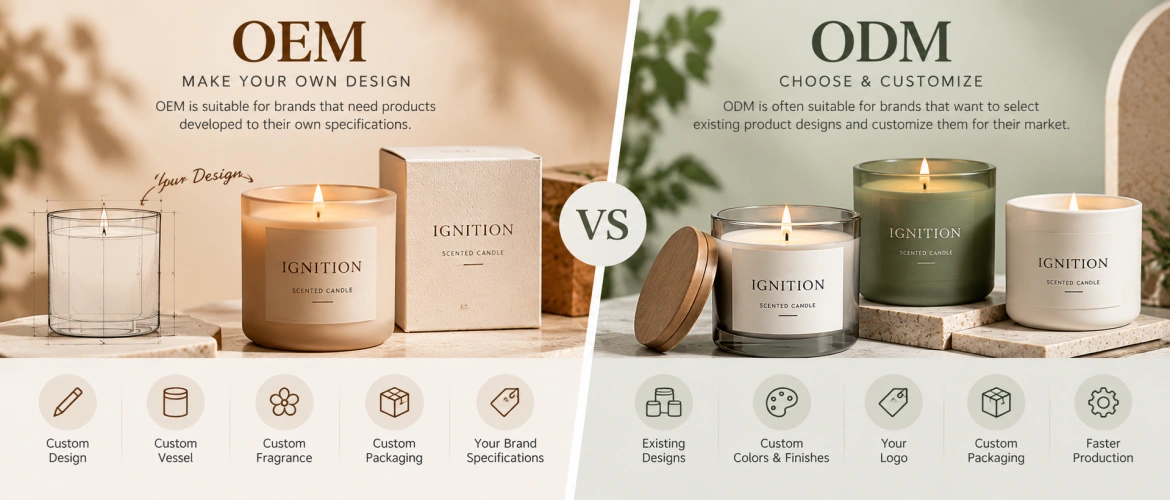
Choosing between OEM and ODM scented candles is an important decision for brands planning to launch or expand a candle collection. The manufacturing model you choose can affect product customization, minimum order quantity (MOQ), development costs, production lead time, and brand differentiation.
OEM candle manufacturing is generally suitable for brands that need products developed to their own specifications, while ODM is often suitable for brands that want to select existing product designs and customize them for their market. The exact scope of each service varies by manufacturer.
For new candle brands, starting with existing vessels and fragrances can reduce development requirements. For established brands seeking distinctive products, custom fragrance development, vessel customization, and specialized packaging may be worth considering.
This guide explains the differences between OEM and ODM scented candles, compares their costs and customization options, and helps you choose the right manufacturing approach for your business.
OEM vs ODM Scented Candles: Quick Comparison
| Factor | OEM Candle Manufacturing | ODM Candle Manufacturing |
|---|---|---|
| Product Design | Based on the buyer’s specifications or approved design | Based primarily on the manufacturer’s existing designs |
| Candle Vessel | Existing or custom-developed | Usually selected from available options |
| Fragrance | Existing or custom-developed | Often selected from an existing fragrance library |
| Branding | Custom logo and packaging | Custom logo and packaging |
| Development | Depends on the project scope | Often simpler when existing products are used |
| MOQ | Depends on materials and customization | May be lower for selected existing products |
| Initial Investment | May be higher for extensive customization | Often lower when using existing components |
| Lead Time | Depends on development and sampling | Often shorter for ready-to-produce products |
| Best For | Brands requiring greater product control | Brands prioritizing speed and a simpler launch |
These are general comparisons, not fixed rules. Some manufacturers offer hybrid services that combine existing products with selected OEM customizations.
What Is OEM Candle Manufacturing?
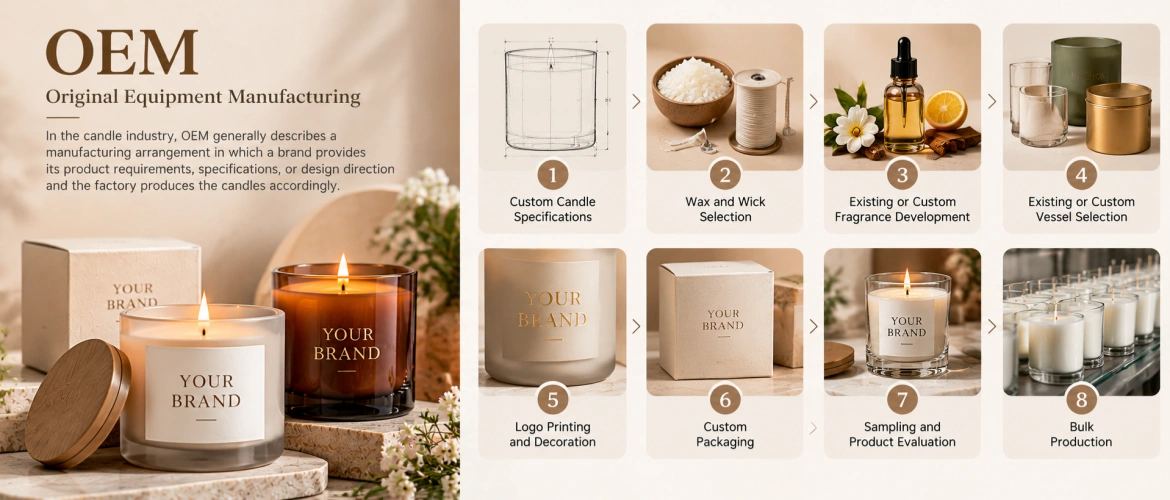
OEM stands for Original Equipment Manufacturing. In the candle industry, it generally describes a manufacturing arrangement in which a brand provides its product requirements, specifications, or design direction and the factory produces the candles accordingly.
Depending on the manufacturer’s capabilities, an OEM candle project may include:
- Custom candle specifications
- Wax and wick selection
- Existing or custom fragrance development
- Existing or custom vessel selection
- Logo printing and decoration
- Custom packaging
- Sampling and product evaluation
- Bulk production
OEM does not necessarily mean that every component must be newly developed. A brand can use an existing glass vessel while customizing the fragrance, branding, and packaging.
Advantages of OEM Candle Manufacturing
Greater control over product specifications
OEM projects allow buyers to define the characteristics that matter most to their brand, subject to manufacturing feasibility.
More opportunities for differentiation
Brands can develop distinctive fragrance combinations, vessel finishes, branding, and packaging instead of relying entirely on standard products.
Better alignment with brand positioning
A carefully specified product can be developed around a particular target market, retail price, or brand identity.
Potential for exclusive product arrangements
If exclusivity is important, the parties can negotiate written terms covering the exact fragrance or design, product categories, territory, duration, and permitted use. Exclusivity should never be assumed simply because a product was custom-developed.
Potential Challenges of OEM
OEM projects can involve additional planning, development, and testing.
Depending on the scope, buyers may need to account for:
- Fragrance development fees
- Custom vessel or mold costs
- Decoration setup
- Packaging development
- Sample evaluation
- Higher minimum quantities for customized components
- Additional development time
The more components that require new development, the more important it becomes to confirm the budget, specifications, and production schedule before proceeding.
What Is ODM Candle Manufacturing?
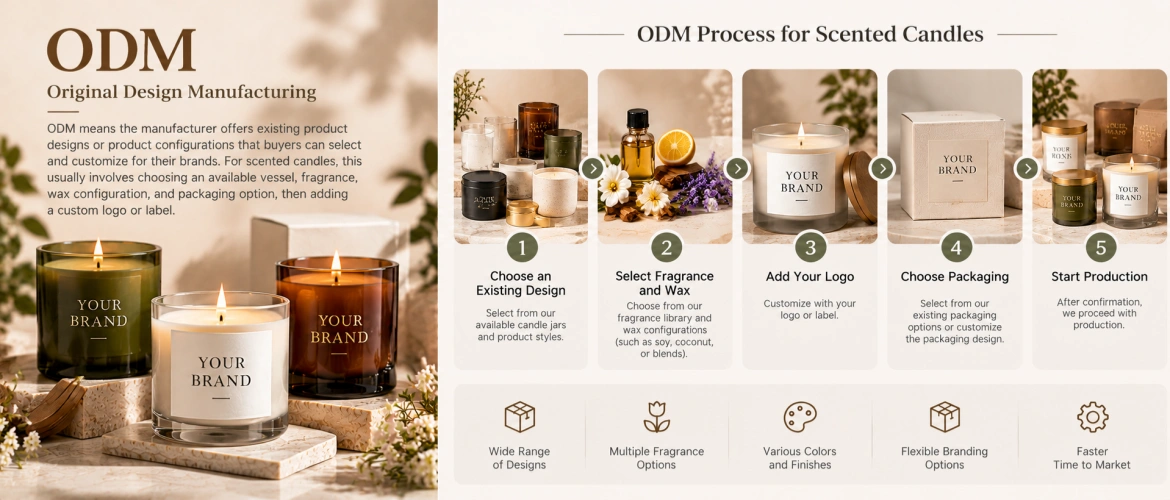
ODM stands for Original Design Manufacturing. In a typical ODM arrangement, the manufacturer offers existing product designs or product configurations that buyers can select and adapt for their brands.
For scented candles, this may mean choosing an available vessel, fragrance, wax configuration, and packaging option, then adding a custom logo or label.
ODM can be a practical option for businesses that want to launch branded candles without developing every component from scratch.
Advantages of ODM Candle Manufacturing
A simpler product development process
Using existing vessels and fragrances can reduce the number of development steps required before production.
Lower initial development requirements
When existing components are suitable, buyers may avoid the expense of developing a new vessel mold or commissioning a completely new fragrance.
More straightforward product selection
Brands can compare available candle styles, sizes, colors, and fragrances before choosing a suitable combination.
Useful for market testing
Existing products can help new brands test customer preferences before investing in more extensive customization.
Potential Limitations of ODM
ODM products may be less distinctive when other brands can access similar vessels or fragrances.
Other considerations include:
- Less freedom to change the original vessel design
- Dependence on available materials and components
- Possible limitations on finishes or decoration
- Competition with brands using similar products
- Product availability and customization restrictions
Using an ODM product does not prevent a brand from developing a distinctive identity. Fragrance selection, logo design, packaging, and collection planning can still create a recognizable brand experience.
OEM vs ODM: Which Offers More Customization?
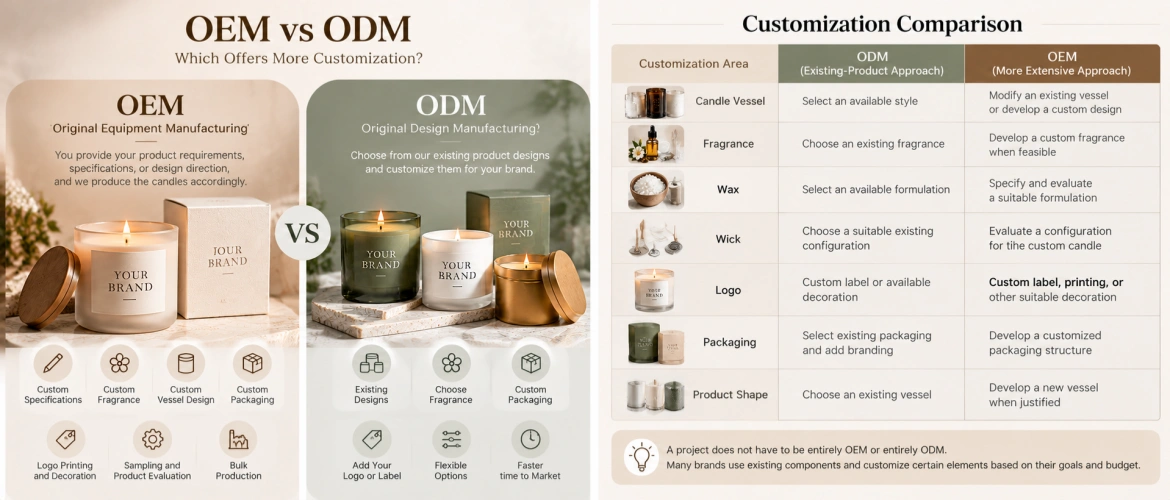
The most useful way to compare OEM and ODM is to examine each product component separately.
| Customization Area | Existing-Product / ODM Approach | More Extensive OEM Approach |
|---|---|---|
| Candle Vessel | Select an available style | Modify an existing vessel or develop a custom design |
| Fragrance | Choose an existing fragrance | Develop a custom fragrance when feasible |
| Wax | Select an available formulation | Specify and evaluate a suitable formulation |
| Wick | Choose a suitable existing configuration | Evaluate a configuration for the custom candle |
| Logo | Custom label or available decoration | Custom label, printing, or other suitable decoration |
| Packaging | Select existing packaging and add branding | Develop a customized packaging structure |
| Product Shape | Choose an existing vessel | Develop a new vessel when justified |
A project does not have to be entirely OEM or entirely ODM. Many brands use existing components for some parts of the product and customize others.
For a broader explanation of private label product options, read our complete guide to private label candles.
OEM vs ODM Candle Costs: What Should You Budget For?
There is no universal price difference between OEM and ODM candles. The total cost depends on the actual product specification, quantity, customization, and shipping arrangements.
Typical Cost Considerations for ODM
When existing products meet the brand’s requirements, the main costs may include:
- Finished candle unit price
- Custom labels or logo decoration
- Packaging
- Samples, where applicable
- Shipping and delivery
Using existing components can reduce development expenses, although the final quotation still depends on the selected product and quantity.
Typical Cost Considerations for OEM
A more extensively customized project may involve:
- Finished candle unit price
- Fragrance development
- Custom vessel or mold development
- Special surface treatments
- Logo printing setup
- Custom packaging
- Sampling and adjustments
- Shipping and delivery
Not every OEM project requires all these expenses. For example, using an existing vessel and customizing only the fragrance and label may require much less development than creating a new vessel, exclusive fragrance, and custom gift box.
For a detailed breakdown of the factors affecting manufacturing costs, see our wholesale scented candle pricing guide.
What Is the MOQ for OEM and ODM Scented Candles?
Minimum order quantity depends on the product and the components being customized. OEM does not automatically mean a high MOQ, and ODM does not guarantee that every product can be ordered in small quantities.
At IGNITION, the following are useful starting points for planning a project.
Existing Private Label Candles
Selected ready-stock private label candle styles can start from 50 pieces per SKU.
This option is suitable for brands that want to use existing vessels and fragrances while adding their own branding.
Explore our private label candle options with MOQ from 50 pieces.
Custom Fragrance Development
For a custom fragrance project, our standard terms are:
- Fragrance development fee: USD 45 per fragrance
- Bulk order MOQ: 200 finished candles per fragrance
- Development time: approximately 7–10 days
- One fragrance adjustment included
These are standard project terms and should be confirmed for the specific brief before payment and development begin.
Fully Custom Candle Vessels
A completely new vessel requiring mold development generally needs a higher order quantity. Typical projects may start around 1,000–2,000 pieces, depending on the vessel, material, production process, and supplier requirements.
Using an existing vessel with customized branding may be a more practical alternative when the initial order quantity is limited.
How Do OEM and ODM Affect Production Lead Time?
Production lead time depends on whether the project uses existing components or requires additional development.
An ODM project using an available vessel, existing fragrance, and standard packaging may be ready for production sooner because fewer development steps are required.
An OEM project involving a custom fragrance, new vessel mold, special decoration, or custom packaging may need additional time for sampling, evaluation, and approval.
At IGNITION, typical planning estimates include:
- Custom fragrance development: approximately 7–10 days
- Bulk candle production: approximately 7–15 days after the relevant specifications and production arrangements are confirmed
These estimates are not guarantees for every project. Material availability, sampling revisions, vessel production, packaging, and order complexity can affect the actual schedule.
For a more detailed overview, read our private label candle production timeline guide.
OEM vs ODM: Which Is Better for a New Candle Brand?
For many new brands, starting with existing products is a sensible way to test the market before investing in extensive customization.
However, the best choice depends on the business plan rather than the company’s age alone.
Choose an Existing-Product Approach If You Want To:
- Launch with a lower initial order quantity
- Test customer interest in different fragrances
- Use an existing vessel
- Simplify product development
- Focus initial investment on branding and marketing
Consider More Extensive OEM Customization If You Want To:
- Develop a distinctive signature fragrance
- Create a unique vessel or product configuration
- Build a differentiated premium collection
- Specify detailed product requirements
- Explore a negotiated exclusive fragrance or design arrangement
A practical strategy is to begin with existing components, validate demand, and then customize the products that demonstrate the strongest market potential.
Can You Combine OEM and ODM?
Yes. A hybrid approach can combine the speed of existing products with selected customization.
For example, a brand might:
- Select an existing glass vessel.
- Choose a fragrance from the manufacturer’s current library.
- Add its own logo and branded packaging.
- Test customer demand.
- Develop a custom fragrance or vessel for a later collection.
Another brand might retain its existing vessel but invest in an exclusive fragrance to make its products more distinctive.
The advantage of a hybrid approach is that customization can be prioritized where it contributes the most to the brand’s identity.
How to Choose an OEM or ODM Candle Manufacturer
Before choosing a supplier, evaluate more than the quoted unit price.
1. Manufacturing Capabilities
Confirm whether the supplier can provide the vessel, fragrance, branding, packaging, and production services required for your project.
2. MOQ and Customization Requirements
Ask for the MOQ of the complete product and confirm whether different components have separate minimum quantities.
3. Sampling and Quality Evaluation
Confirm how samples are produced, what they include, whether adjustments are available, and how final approval is handled.
4. Production Lead Time
Ask the supplier to distinguish development time, sampling time, bulk production time, and international shipping time.
5. Intellectual Property and Exclusivity
If you require an exclusive fragrance, vessel design, or other intellectual property arrangement, specify the scope in a written agreement. Confirm who owns the relevant design or formula and what each party is permitted to use.
6. Shipping and Total Landed Cost
Compare the complete quotation, including packaging and shipping terms, rather than comparing factory unit prices alone.
What Information Should You Send a Candle Manufacturer?
Providing a clear brief helps the manufacturer recommend an appropriate production model and prepare a more accurate quotation.
Before requesting a quote, prepare as much of the following information as possible:
- Candle style and size: Reference image, vessel type, or target wax weight
- Order quantity: Estimated total pieces and quantity per fragrance
- Fragrance requirements: Existing fragrances or a custom fragrance brief
- Wax and wick: Preferred materials, if known
- Branding: Logo artwork and preferred decoration method
- Packaging: Standard box or custom packaging requirements
- Customization: Existing vessel, modified vessel, or fully custom design
- Destination: Country and ZIP or postal code
- Target delivery date: Your expected launch or delivery schedule
You do not need to have every detail finalized before contacting a manufacturer. A good supplier should be able to help you identify which specifications need to be decided first.
Frequently Asked Questions
What is the difference between OEM and ODM scented candles?
OEM generally means producing candles according to the buyer’s specifications or approved design. ODM generally means selecting and adapting products based on the manufacturer’s existing designs. The exact service scope varies by supplier.
Is OEM more expensive than ODM?
OEM can involve higher development costs when a project requires custom fragrances, vessels, molds, or packaging. However, not every OEM project is expensive, and the actual cost depends on the components being customized and the order quantity.
Is ODM suitable for a new candle brand?
Yes. Using existing vessels and fragrances can simplify product development and help new brands test the market. Selected IGNITION ready-stock private label candle styles can start from 50 pieces per SKU.
Can I customize the fragrance in an ODM project?
This depends on the manufacturer’s service options. Some projects use existing fragrances, while others combine an existing vessel with a custom-developed fragrance. At IGNITION, custom fragrance development typically requires a USD 45 development fee per fragrance and a 200-piece bulk MOQ per fragrance.
Does OEM mean that I own the fragrance formula?
Not automatically. Ownership, permitted use, confidentiality, and exclusivity depend on the agreement between the parties. These terms should be documented explicitly before development begins.
Can I start with ODM and switch to OEM later?
Yes. A brand can begin with existing products and later invest in more extensive customization when demand and budget justify it. The transition should account for new sampling, component requirements, MOQs, and production timelines.
What is the MOQ for OEM scented candles?
There is no single MOQ for all OEM projects. It depends on the vessel, fragrance, decoration, packaging, and production requirements. Selected existing private label styles can start from 50 pieces per SKU, while custom fragrance projects typically require 200 finished candles per fragrance.
How long does OEM candle production take?
The timeline depends on the project. Custom fragrance development typically takes around 7–10 days, while bulk production often takes 7–15 days after specifications and arrangements are confirmed. Custom vessels, packaging, and additional sampling can extend the schedule.
Start Your OEM or ODM Candle Project with IGNITION
The right manufacturing model should match your brand’s budget, desired level of customization, target market, and launch schedule.
IGNITION supports private label and OEM/ODM scented candle projects, including:
- Existing candle styles and vessels
- Custom fragrance development
- Vessel color and surface customization
- Logo and label decoration
- Custom packaging
- Sampling and bulk production
If you are launching your first candle collection, we can help you evaluate existing-product options before committing to more extensive customization. If your brand already has a detailed product brief, we can assess the feasibility, MOQ, and development requirements.
To begin, send us your preferred candle style, estimated quantity, fragrance requirements, branding ideas, packaging preferences, and destination.
Contact IGNITION to discuss your private label candle project and request a tailored quotation.