Private Label Scented Candle Manufacturer in China | IGNITION

Custom Candle Fragrance Development: A Guide for Private Label Brands
A custom candle fragrance allows a brand to create a scent that better reflects its identity, target customer, product concept, or collection theme.
Unlike selecting a fragrance from an existing scent library, custom fragrance development involves creating and evaluating a new fragrance direction before it is approved for candle production.
At IGNITION, we support both existing fragrance selection and custom fragrance development for private label and OEM/ODM candle projects.
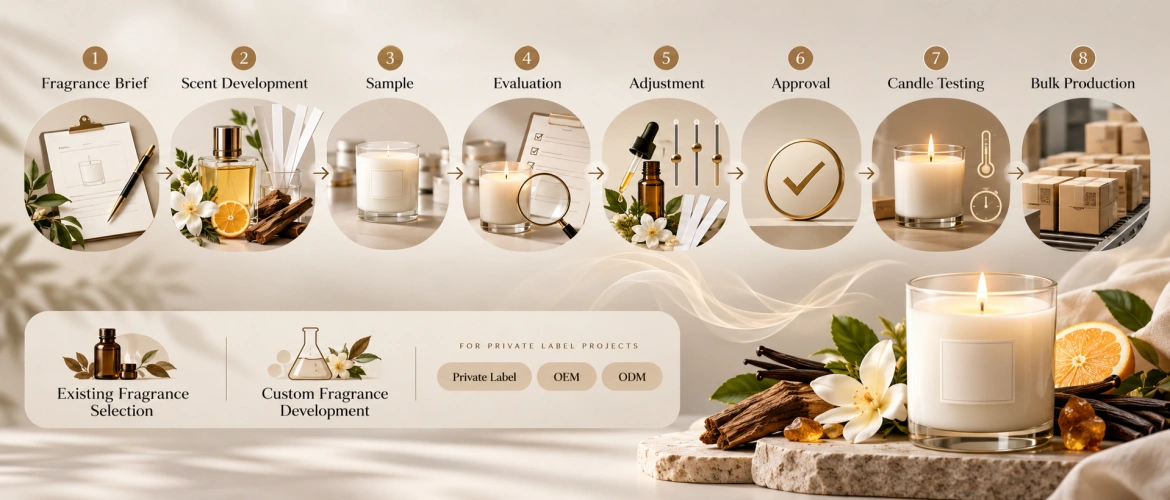
The typical process includes:
Fragrance Brief → Scent Development → Sample → Evaluation → Adjustment → Approval → Candle Testing → Bulk Production
This guide explains how custom candle fragrances are developed, what information brands should provide, how samples are evaluated, and what can affect MOQ, cost, and development time.
What Is a Custom Candle Fragrance?
A custom candle fragrance is a scent developed according to a specific fragrance brief rather than simply selected from an existing fragrance collection.
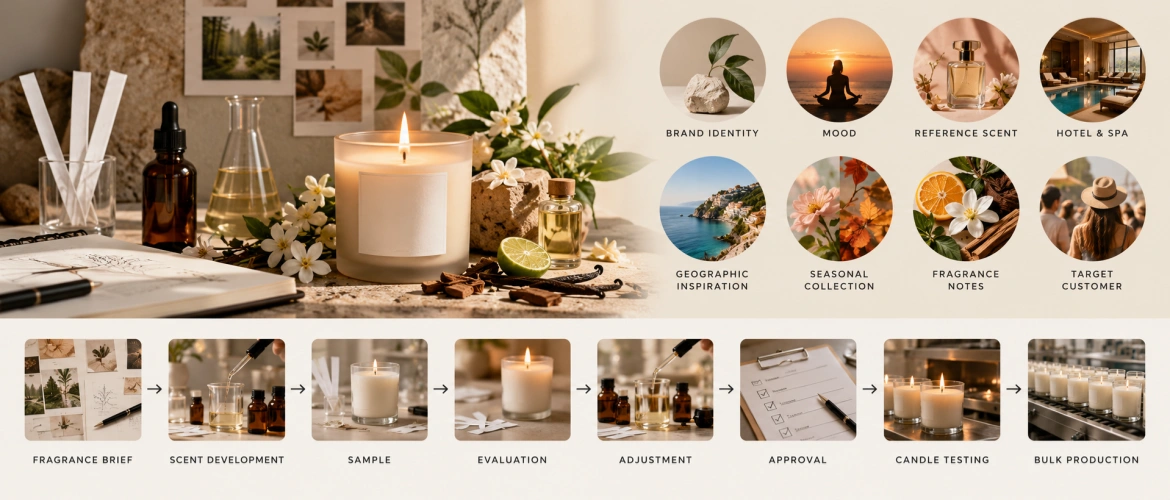
The fragrance may be developed around:
- A brand identity
- A specific mood or atmosphere
- A reference perfume or scent
- A hotel or spa concept
- A geographic inspiration
- A seasonal collection
- Specific fragrance notes
- A target customer profile
For example, a brand may request a fragrance built around:
Bergamot + Haitian Vetiver + Warm Amber + Sandalwood + Soft Spices
Another project may require:
White Musk + Sandalwood + Soft Woods
for a clean, warm, and comforting home fragrance.
The purpose of custom fragrance development is not simply to create a pleasant scent. It is to create a fragrance direction that fits the intended product and brand positioning.
Existing Fragrance vs Custom Fragrance: What Is the Difference?
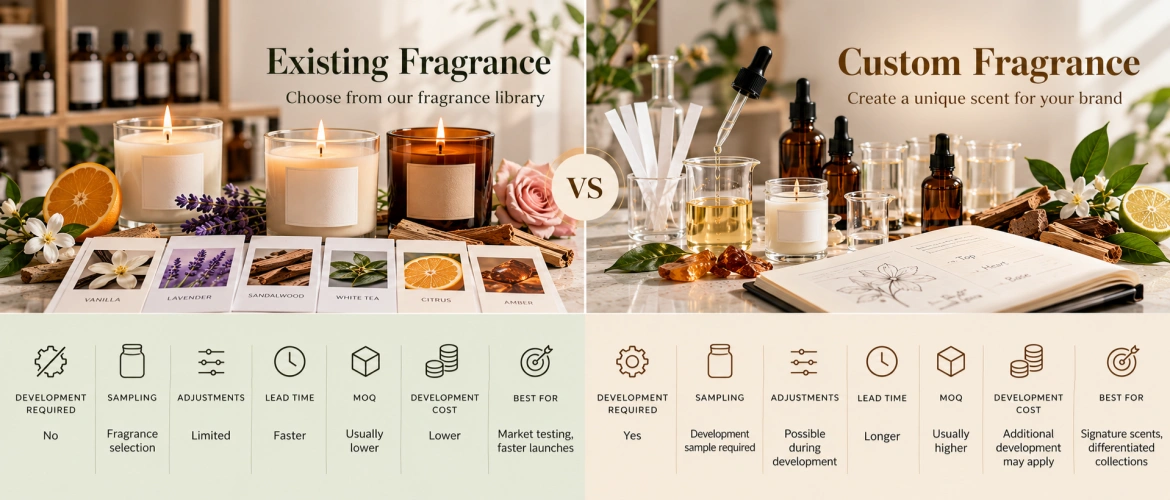
Brands do not always need to develop a fragrance from scratch.
For many new private label candle projects, selecting from an existing fragrance library is faster and more economical.
| Option | Existing Fragrance | Custom Fragrance |
|---|---|---|
| Development Required | No | Yes |
| Sampling | Fragrance selection | Development sample required |
| Adjustments | Limited | Possible during development |
| Lead Time | Faster | Longer |
| MOQ | Usually lower | Usually higher |
| Development Cost | Lower | Additional development may apply |
| Best For | Market testing, faster launches | Signature scents, differentiated collections |
If your main goal is to launch quickly and test the market, an existing fragrance may be the more practical starting point.
If fragrance is a major part of your brand identity, developing a signature scent may provide greater differentiation.
How Does Custom Candle Fragrance Development Work?
Custom fragrance development usually follows several stages.
The exact process may vary depending on the fragrance complexity, reference materials, candle formulation, and number of adjustments required.
Create a Fragrance Brief
The first step is explaining what you want the fragrance to smell like.
A useful fragrance brief does not need to use professional perfumery terminology.
You can describe:
- The desired mood
- Key fragrance notes
- Fragrance family
- Target customer
- Product positioning
- Reference fragrances
- Scents you like
- Scents you want to avoid
For example:
We want a sophisticated and luxurious fragrance with bergamot, Haitian vetiver, warm amber, sandalwood, and subtle Caribbean-inspired spices. The overall scent should feel elegant, warm, refined, and suitable for a premium candle collection.
This gives the fragrance developer much more direction than simply requesting a “luxury scent.”
How Should You Describe the Fragrance You Want?
There are several ways to communicate a fragrance concept.
Fragrance Family
You can begin with a general fragrance family such as:
- Woody
- Amber
- Floral
- Fresh
- Citrus
- Fruity
- Gourmand
- Musk
- Aromatic
- Spicy
You can then narrow the direction using specific notes and mood descriptions.
For example:
Woody + Amber + Warm + Elegant
or:
Fresh + Clean + White Musk + Soft Woods
Top, Middle, and Base Notes
If you already have a clear fragrance concept, you can organize it using top, middle, and base notes.
Top Notes
These are the notes that create the first impression of the fragrance.
Examples include:
- Bergamot
- Lemon
- Orange
- Pear
- Green notes
- Marine notes
Middle Notes
These form the heart of the fragrance.
Examples include:
- Rose
- Jasmine
- Tuberose
- Lavender
- Spices
- Fig
Base Notes
These usually provide depth, warmth, and lasting character.
Examples include:
- Sandalwood
- Cedarwood
- Vetiver
- Amber
- Musk
- Vanilla
- Oud
- Tonka bean
You do not need to specify every layer.
A fragrance developer can also help translate a general concept into a more structured fragrance direction.
Can You Use a Perfume or Existing Fragrance as a Reference?
A reference fragrance can be useful for communicating the direction you like.
For example, you may provide:
- The name of a perfume
- A fragrance description
- A note pyramid
- A fragrance sample
- A room fragrance
- A candle you like
- Several reference scents
The purpose of a reference is to help communicate characteristics such as:
- Sweetness
- Freshness
- Warmth
- Woodiness
- Floral intensity
- Spice level
- Overall mood
A reference should generally be treated as inspiration and direction, rather than an instruction to reproduce another brand’s proprietary fragrance exactly.
For brands seeking a distinctive identity, the goal should be to develop a fragrance suitable for their own collection.
Do You Need to Send a Physical Fragrance Sample?
Not always.
If you can provide a sufficiently detailed fragrance brief, fragrance notes, reference products, or scent descriptions, development may be able to begin without a physical sample.
A physical reference can be useful when:
- The scent is difficult to describe
- A specific balance is important
- Written fragrance notes do not accurately represent the scent
- The project requires comparison with a physical reference
Whether a physical sample is necessary should be evaluated according to the project.
What Happens After the Fragrance Brief Is Confirmed?
Once the fragrance direction is clear, the fragrance development stage begins.
The fragrance developer interprets the brief and creates a formulation intended to match the desired scent profile.
The process may involve balancing:
- Top notes
- Heart notes
- Base notes
- Sweetness
- Freshness
- Floral intensity
- Woodiness
- Warmth
- Diffusion
- Overall character
The first version is then prepared for evaluation.
Custom fragrance development is an iterative process, so the first sample should be treated as a development stage rather than automatically assumed to be the final fragrance.
How Do You Evaluate a Custom Fragrance Sample?
When evaluating a fragrance sample, avoid judging it only by whether you “like” or “dislike” it.
More useful feedback includes:
- Too sweet
- Not sweet enough
- Too floral
- More woody
- Less oud
- More sandalwood
- Softer musk
- Stronger amber
- Fresher opening
- Less citrus
- More elegant
- Too heavy
- Too light
- Warmer dry-down
For example:
The overall direction is correct, but we would like less vanilla, more sandalwood, and a slightly cleaner opening.
This type of feedback gives the fragrance developer clear adjustment instructions.
Can a Custom Fragrance Be Adjusted?
Yes, fragrance development may include adjustments based on sample feedback.
The number and scope of revisions depend on the project and the agreed development terms.
Adjustments may involve:
- Increasing or reducing specific notes
- Changing sweetness
- Modifying floral intensity
- Adding warmth
- Increasing woody character
- Softening musk
- Adjusting freshness
- Changing the balance between top, middle, and base notes
It is important to provide specific feedback after each sample.
Repeatedly changing the overall fragrance concept can extend the development process.
For example, changing from:
Warm Amber + Sandalwood
to:
Fresh Citrus + Marine
is not a minor adjustment. It is effectively a new fragrance direction.
Why Does a Fragrance Need to Be Tested in Candle Wax?
A fragrance can smell different in a bottle, fragrance sample, or finished candle.
This is why evaluating the fragrance direction alone is not always enough.
The fragrance should also be considered in the intended candle formulation.
Factors that can influence fragrance performance include:
- Wax formulation
- Fragrance load
- Candle diameter
- Wick type
- Wick size
- Vessel:Vessel size and material are also important considerations when selecting custom candle jars for a fragrance collection.
- Cure time
- Burning conditions
A fragrance that smells strong before burning does not automatically produce the best-performing candle.
The final candle needs a suitable balance between the fragrance, wax, wick, and vessel.
What Is Cold Throw and Hot Throw?
Two terms commonly used when evaluating scented candles are cold throw and hot throw.
Cold Throw
Cold throw describes how the candle smells when it is not burning.
Customers often experience cold throw when they first open or smell a candle.
Hot Throw
Hot throw describes fragrance performance while the candle is burning.
It is influenced by the complete candle system, including:
Fragrance + Wax + Wick + Vessel + Candle Size
A fragrance with good cold throw does not always produce the same hot throw performance.
For this reason, finished candle testing is important when fragrance performance is a major requirement.
Does a Higher Fragrance Load Always Mean a Stronger Candle?
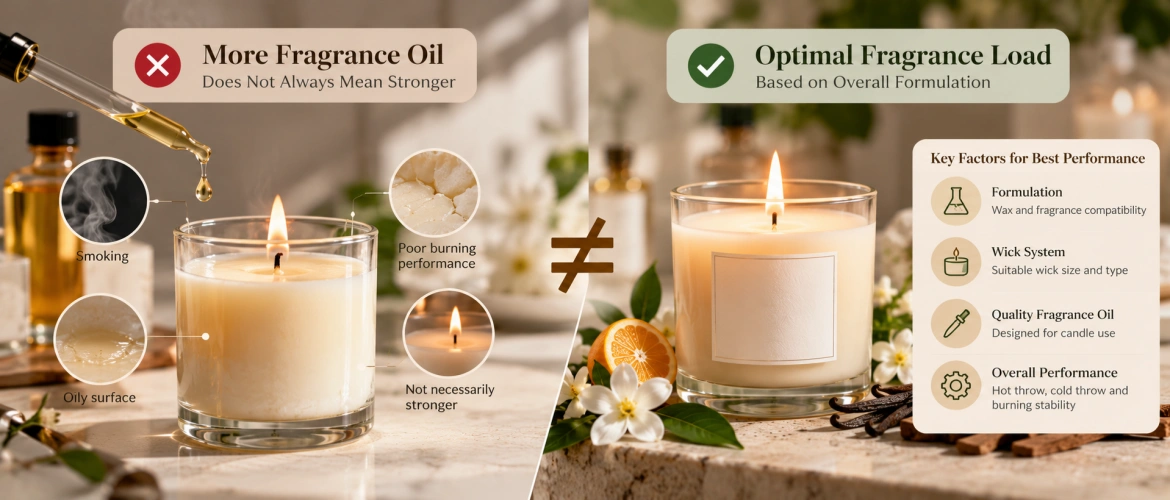
Not necessarily.
Adding more fragrance oil does not automatically guarantee stronger or better fragrance performance.
The appropriate fragrance load depends on the formulation and how the fragrance interacts with the wax and wick system.
Too much fragrance may also create production or burning-performance issues.
Rather than focusing only on fragrance percentage, brands should evaluate the overall performance of the finished candle.
The goal is not simply:
More Fragrance Oil
but:
Balanced Fragrance Performance + Stable Candle Formulation
What Documents May Be Available for Candle Fragrances?
Depending on the fragrance, supplier, destination market, and project requirements, fragrance-related documentation may include:
- SDS (Safety Data Sheet)
- IFRA-related documentation
- Allergen information
- Other product or fragrance documentation required for the destination market
Documentation requirements vary by market and product.
For this reason, brands should confirm the destination country and any specific compliance requirements before bulk production.
What Is IFRA?
IFRA refers to the International Fragrance Association.
IFRA Standards provide a framework for the safe use of fragrance ingredients in different product categories.
For candle projects, the relevant documentation should be reviewed according to the actual fragrance and intended application.
An IFRA document should not be treated as a universal certificate that automatically confirms compliance with every regulatory requirement in every market.
Brands selling into markets such as the United States, European Union, United Kingdom, or other regions should evaluate the requirements applicable to their finished products and destination market.
What Is an SDS?
An SDS, or Safety Data Sheet, provides safety-related information about a substance or mixture.
For fragrance oils, an SDS may contain information such as:
- Hazard identification
- Composition information
- Handling and storage
- First-aid measures
- Fire-fighting measures
- Transport information
- Regulatory information
An SDS for a fragrance oil is not the same as complete regulatory documentation for the finished candle.
The required documentation depends on the final product and destination market.
What Is the MOQ for Custom Candle Fragrance Development?
Custom fragrance projects generally have a higher MOQ than private label projects using existing fragrances.
This is because custom fragrance development may involve:
- Formula development
- Fragrance sampling
- Adjustments
- Fragrance production
- Raw material preparation
- Candle testing
- Production setup
The exact MOQ depends on the fragrance project, candle specification, vessel, quantity, and other customization requirements.
If your initial order quantity is small, selecting from an existing fragrance collection may be more practical.
Brands testing the market can also explore selected private label candles with a 50-piece MOQ before investing in custom fragrance development.
For larger projects or brands building a long-term signature collection, custom fragrance development may be a better fit.
How Much Does Custom Fragrance Development Cost?
Custom fragrance development is not the same as purchasing an existing fragrance from a standard fragrance library.
Additional development costs may apply for:
- Fragrance formulation
- Development samples
- Adjustments
- Finished candle samples
- Shipping samples
- Testing requirements
The actual cost depends on the project.
Before development begins, brands should confirm:
- Development fee
- What the fee includes
- Number of fragrance directions
- Sample format
- Revision policy
- Finished candle sample requirements
- MOQ after fragrance approval
This makes it easier to understand the complete development budget before proceeding.
How Long Does Custom Fragrance Development Take?
There is no single development time that applies to every fragrance.
The timeline depends on factors such as:
- Complexity of the fragrance brief
- Number of fragrances
- Availability of reference materials
- Number of sample rounds
- Customer feedback speed
- Formula adjustments
- Candle testing requirements
A fragrance that is approved after the first sample will naturally move faster than a fragrance requiring several development rounds.
Custom fragrance development time should also be separated from:
Bulk Candle Production Time + International Shipping Time
This distinction is important when planning a product launch.
Custom Fragrance vs Existing Fragrance: Which Should You Choose?
The right option depends on your business stage and product strategy.
Choose an Existing Fragrance If:
- You want to launch quickly
- You are testing a new market
- You want a lower initial MOQ
- You want to compare several fragrances
- Fragrance exclusivity is not essential
- You want to reduce initial development costs
Consider a Custom Fragrance If:
- Fragrance is central to your brand identity
- You want a signature scent direction
- You have a clear fragrance concept
- You are developing a premium collection
- You are planning larger production volumes
- You want greater product differentiation
A new candle brand does not necessarily need a custom fragrance for its first order.
Many brands can begin with carefully selected existing fragrances and move into signature fragrance development after validating the market.
How Can You Make Custom Fragrance Development Faster?
The best way to shorten development time is to provide a clear fragrance brief from the beginning.
Before development starts, prepare:
1. Fragrance Direction
Example:
Woody / Amber / Warm / Sophisticated
2. Preferred Notes
Example:
Bergamot / Vetiver / Sandalwood / Amber
3. Notes to Avoid
Example:
No strong patchouli or overly sweet vanilla
4. Desired Mood
Example:
Luxury hotel / warm / elegant / sophisticated
5. Reference Fragrances
Provide one or more references if available.
6. Target Product
For example:
200 g soy-coconut scented candle in a heavy glass vessel
7. Target Market
For example:
Premium home fragrance brand for the U.S. market
The clearer the brief, the easier it is for the fragrance developer to understand the intended direction.
Example of a Custom Candle Fragrance Brief
A useful fragrance brief may look like this:
| Requirement | Example |
|---|---|
| Product | Premium scented candle |
| Fragrance Family | Woody Amber |
| Top Notes | Bergamot, subtle spice |
| Middle Notes | Haitian vetiver |
| Base Notes | Sandalwood, warm amber |
| Mood | Sophisticated, warm, luxurious |
| Sweetness | Low to medium |
| Intensity | Strong but refined |
| Target Customer | Premium home fragrance buyer |
| Target Market | United States |
| Notes to Avoid | Overly sweet vanilla |
| Reference | Luxury hotel fragrance atmosphere |
This type of brief provides a much clearer development direction than simply requesting a “luxury candle fragrance.”
What Happens After the Custom Fragrance Is Approved?
After the fragrance is approved, the project can move toward final candle confirmation and bulk production.
The next steps may include:
Fragrance Approval
↓
Finished Candle Sample
↓
Wax & Wick Confirmation
↓
Vessel Confirmation
↓
Logo & Packaging Approval
Brands can also compare sticker labels vs screen printing on candle jars before confirming the final branding method.
↓
Bulk Production
↓
Quality Control
↓
International Shipping
If the fragrance has already been approved but the vessel, packaging, or branding is still being developed, those stages should be completed before the final production schedule is confirmed.
Frequently Asked Questions
Can you create a completely custom fragrance for candles?
Yes. A custom fragrance can be developed according to a fragrance brief, preferred notes, mood, reference fragrance, and product positioning. Development requirements and MOQ depend on the project.
Can I choose an existing fragrance instead?
Yes. Selecting from an existing fragrance collection is generally faster and more suitable for lower-MOQ private label projects.
Do I need to know top, middle, and base notes?
No. You can describe the fragrance using mood, fragrance family, reference scents, or notes you like and dislike. A more detailed note structure can be developed from the brief.
Can I send a perfume as a fragrance reference?
A perfume or other fragrance product can be used as a reference to communicate the direction you like. The goal should be to use it as inspiration rather than reproduce another brand’s proprietary fragrance exactly.
Can the first fragrance sample be modified?
Depending on the development terms, adjustments may be possible after evaluating the first sample. Clear and specific feedback helps make revisions more efficient.
Does custom fragrance development increase the MOQ?
Generally, yes. Custom fragrance projects often require higher minimum quantities than projects using available fragrances because additional development and production preparation are required.
Does a higher fragrance percentage make the candle stronger?
Not necessarily. Fragrance performance depends on the complete candle formulation, including wax, wick, vessel, fragrance, and burning conditions.
Can you provide IFRA and SDS documentation?
Relevant fragrance documentation may be available depending on the fragrance, supplier, project, and destination-market requirements. Documentation should be confirmed for the specific fragrance before bulk production.
Should I develop a custom fragrance for my first candle order?
Not necessarily. For a new brand testing the market, selecting existing fragrances can reduce development time, MOQ, and initial investment. Custom fragrance development can be introduced later when a signature scent becomes strategically important.
Start Your Custom Candle Fragrance Project
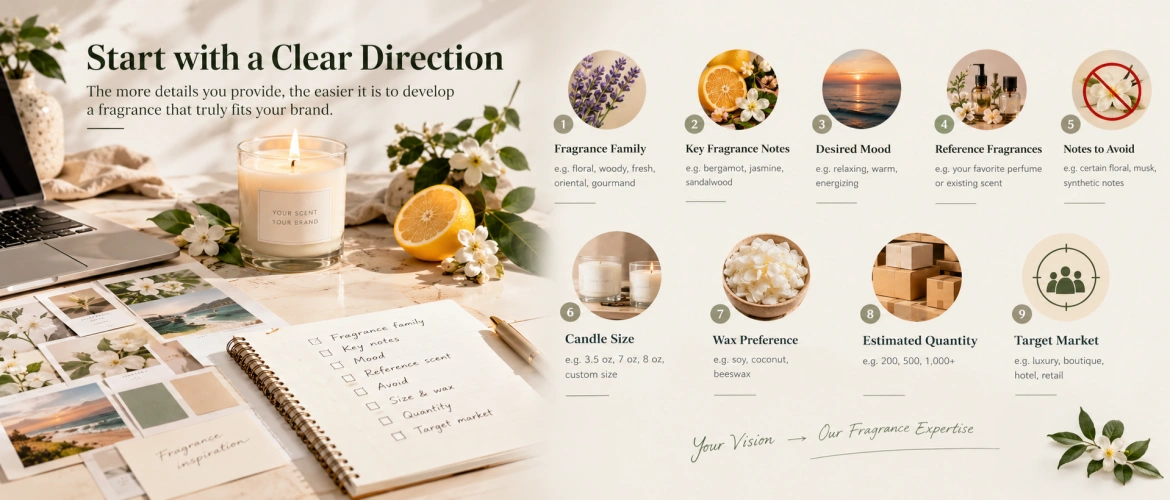
A successful custom candle fragrance starts with a clear direction.
Before contacting a manufacturer, prepare as much information as possible about your:
- Preferred fragrance family
- Key fragrance notes
- Desired mood
- Reference fragrances
- Notes you want to avoid
- Candle size
- Wax preference
- Estimated quantity
- Target market
IGNITION supports fragrance selection and custom fragrance development as part of private label and OEM/ODM scented candle projects.
If you already have a fragrance concept, send us your fragrance notes, reference scent, target candle style, estimated quantity, and destination.
We can then evaluate whether an existing fragrance is suitable or whether custom fragrance development is the better option for your project.
Request Custom Fragrance Development →