Private Label Scented Candle Manufacturer in China | IGNITION



How to Create a Signature Scent for Your Candle Brand
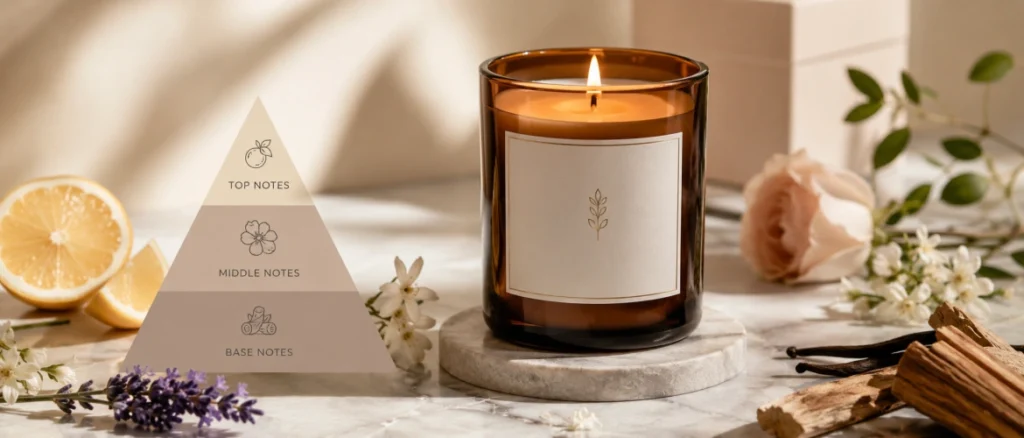
Walk into a store filled with scented candles and you may notice the same fragrance ideas appearing again and again: vanilla, lavender, sandalwood, citrus, and amber.
These fragrances can all smell good, but smelling good is not enough to make a candle brand memorable.
A signature scent gives your brand a recognizable fragrance identity. It connects the scent with your brand personality, target customer, product positioning, and the experience you want customers to remember.
To create a signature scent for your candle brand, start with your brand identity and target customer, define the emotion you want the fragrance to create, choose a distinctive scent direction, and make sure the final fragrance works consistently across your candle collection.
The goal is not to create the most complicated fragrance. It is to create one that feels unmistakably connected to your brand.
What Is a Signature Scent for a Candle Brand?
A signature scent is a fragrance that customers can strongly associate with a particular brand, collection, or product experience.
It is different from simply choosing a popular fragrance from a supplier’s catalog.
For example, two candle brands might both sell woody candles. One may combine soft woods, amber, and musk to create a warm luxury atmosphere, while another may use pine, cedarwood, moss, and herbs to create an outdoor-inspired identity.
Both are woody fragrances, but they communicate very different brand personalities.
A strong signature scent should answer a simple question:
If customers smelled this fragrance without seeing the packaging, could it eventually remind them of your brand?
That is the level of recognition you are trying to build.
Does a Signature Scent Have to Be Completely Unique?
Not necessarily.
A signature scent can come from several approaches:
- Selecting an existing fragrance that strongly matches your brand
- Adjusting an existing fragrance direction
- Developing a fully custom fragrance
- Creating a recognizable scent family across several products
The right approach depends on your budget, order volume, launch schedule, and how much differentiation your brand needs.
For a new candle business testing the market, a carefully selected existing fragrance may be enough.
For an established brand building a premium or long-term collection, a custom fragrance may provide stronger differentiation.
How Do You Define Your Brand’s Scent Identity?
Before choosing fragrance notes, define what your brand should smell like.
I recommend starting with the brand rather than opening a fragrance catalog.
Ask yourself:
- Who is my target customer?
- What does my brand represent?
- What emotions should customers associate with it?
- Is the positioning accessible, premium, luxury, natural, playful, minimalist, or something else?
- Where will customers use the candle?
- What visual style does the packaging communicate?
- Which fragrances already exist in my market?
- Which scent directions should my brand avoid?
The answers create your scent identity.
For example, a minimalist wellness brand might want a fragrance that feels clean, calm, and natural.
A luxury hotel-inspired candle brand might want something warmer, deeper, and more sophisticated.
An outdoor lifestyle brand could build around woods, herbs, moss, pine, smoke, or mineral notes.
The fragrance should feel like an extension of the brand rather than a separate product decision.
Turn Brand Words Into Scent Words
One technique I use is translating brand language into fragrance language.
| Brand Direction | Possible Scent Direction |
|---|---|
| Clean & Minimal | Citrus, tea, herbs, soft woods |
| Warm & Luxurious | Amber, sandalwood, vanilla, musk |
| Natural & Grounded | Cedarwood, moss, herbs, vetiver |
| Romantic & Elegant | Rose, jasmine, soft musk |
| Fresh & Energetic | Bergamot, grapefruit, green notes |
| Dark & Sophisticated | Oud, leather, tobacco, woods |
These are starting points rather than fixed formulas.
A luxury fragrance does not always need oud, and a wellness fragrance does not always need lavender. What matters is whether the complete scent supports the identity you are building.
How Do You Choose a Distinctive Fragrance Direction?
One of the biggest mistakes a candle brand can make is choosing a scent only because it is currently popular.
Popular fragrances can be useful commercially, but following trends too closely can make products difficult to distinguish from competitors.
Instead, look for a direction that balances three factors:
Customer appeal + brand relevance + differentiation
If you focus only on customer appeal, the fragrance may feel generic.
If you focus only on uniqueness, customers may find the scent difficult to understand or use.
A strong signature scent sits somewhere between familiarity and originality.
Start With a Familiar Anchor
A useful approach is to begin with something customers already understand and then build a more distinctive character around it.
For example:
Sandalwood
could become:
Sandalwood + Fig + Tea + Soft Musk
Or:
Cedarwood
could become:
Cedarwood + Bergamot + Moss + Amber
The familiar note makes the fragrance approachable, while the supporting direction helps give it personality.
Avoid Copying a Competitor’s Signature
Competitor research is useful for understanding the market, but it should help you identify opportunities rather than create a fragrance that imitates another brand.
Instead of asking:
How can I make my candle smell like this brand?
Ask:
What fragrance territory is missing in my category?
That question is much more useful for long-term brand building.
How Should Fragrance Notes Reflect Your Brand Identity?
Fragrance notes should support the story customers already see in your brand.
A candle presented in a matte black vessel with minimalist typography creates a very different expectation from one packaged in a pastel floral box.
The fragrance should make that visual promise feel complete.
For example, imagine a candle brand positioned around quiet luxury.
A very sweet tropical fruit fragrance might conflict with that positioning, even if customers like the scent on its own.
A combination built around woods, tea, amber, iris, or soft musk may create a more consistent experience.
The important point is not that certain notes belong exclusively to certain brand styles.
It is consistency between scent, design, audience, and positioning.
Think in Fragrance Families Before Individual Notes
Before choosing individual materials, it is often easier to define the broader fragrance family.
Possible directions include:
- Woody
- Floral
- Fresh
- Citrus
- Green
- Aromatic
- Fruity
- Gourmand
- Amber
- Spicy
Once the family is clear, individual notes can be selected to create a more distinctive interpretation.
This prevents the fragrance concept from becoming a random collection of ingredients.
What Makes a Signature Scent Memorable?
A memorable scent does not have to be loud.
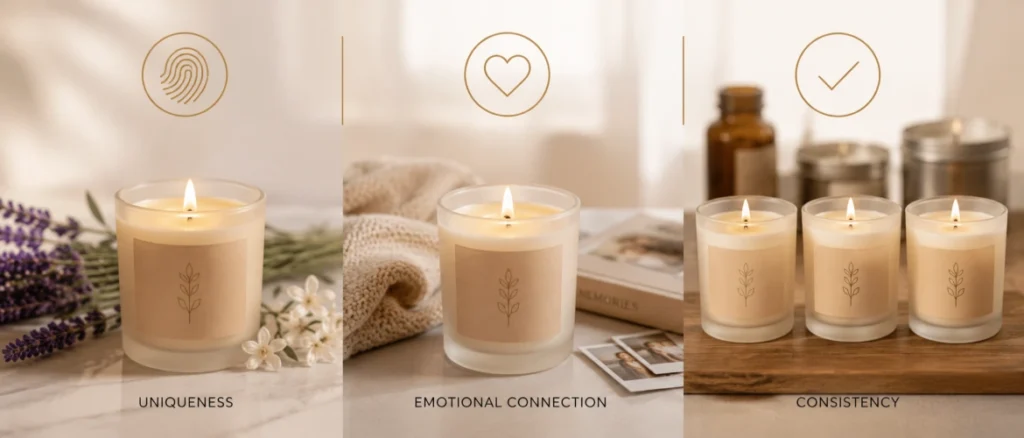
In fact, one of the most important qualities is clarity.
Customers should be able to understand the overall personality of the fragrance even if they cannot identify every individual note.
I normally look for several characteristics.
A Recognizable Character
The fragrance should have a clear identity.
It might feel:
- Warm and woody
- Clean and airy
- Dark and smoky
- Soft and comforting
- Green and botanical
- Bright and energetic
If the scent tries to communicate too many ideas at once, its identity can become unclear.
An Emotional Connection
People often remember fragrance through association.
A scent may remind someone of a forest, hotel, spa, garden, holiday, library, coastal home, or another familiar environment.
For a candle brand, this emotional association can be more powerful than simply listing fragrance notes.
Instead of describing only:
Cedarwood, amber, and bergamot
you can also communicate the experience:
A warm, modern woody scent inspired by a quiet evening in a contemporary mountain retreat.
The notes explain the fragrance.
The story gives customers a reason to remember it.
Consistency
A signature scent also needs to perform consistently.
If customers love the first candle but the next production batch smells noticeably different, the fragrance cannot reliably function as part of the brand identity.
That is why fragrance selection should consider not only creativity but also repeatability and production feasibility.
Should Your Brand Have One Signature Scent or a Signature Collection?
A signature fragrance does not always have to mean one candle.
Some brands are better served by creating a recognizable fragrance collection.
For example, a brand might develop three scents around the same identity:
Morning
Fresh citrus, tea, and soft woods
Evening
Amber, sandalwood, and musk
Night
Cedarwood, incense, and darker woods
The fragrances are different, but they still feel as though they belong to the same brand.
This approach works particularly well when you want to expand your product range without losing consistency.
Use a Common Fragrance Thread
One way to connect a collection is to repeat a recognizable note, accord, or overall character.
For example, several fragrances might share:
- A particular woody base
- A soft tea accord
- A recognizable amber character
- A botanical direction
- A consistent clean musk finish
The connection should be noticeable enough to create continuity without making every candle smell the same.
How Can a Signature Scent Strengthen Your Candle Brand?
Packaging creates visual recognition.
A signature fragrance can create sensory recognition.
When these elements work together, the product becomes more than a candle with an attractive label.
It becomes a more complete brand experience.
It Creates Differentiation
Stock fragrances are useful for many candle businesses, particularly during early product testing.
However, competitors may have access to similar fragrance directions.
A distinctive signature scent gives your brand another point of differentiation beyond jar shape, label design, and packaging.
It Supports Brand Recognition
Repeated exposure to a consistent fragrance can help customers connect that scent experience with your brand.
This is particularly valuable for brands that sell through:
- Retail stores
- Hotels
- Spas
- Corporate gifting
- Lifestyle boutiques
- E-commerce
- Subscription boxes
The fragrance becomes another recognizable brand element.
It Can Support Premium Positioning
Premium customers are often buying more than wax, fragrance oil, and a candle vessel.
They are buying the overall experience.
A fragrance developed specifically around the brand can help support that experience, especially when combined with high-quality candle vessels, packaging, materials, and storytelling.
However, custom fragrance alone does not automatically make a candle premium. The complete product must support the positioning.
How Do You Test Whether a Scent Fits Your Brand?
Do not evaluate a potential signature scent only by asking:
Do I like this?
The founder’s personal preference matters, but the fragrance needs to work for the target customer.
I prefer asking more specific questions:
- What three words describe this scent?
- What type of brand does it remind you of?
- Does it feel premium, accessible, natural, modern, or traditional?
- Where would you expect to smell it?
- Does it match the packaging?
- What emotion does it create?
- Would you recognize it again?
- Which part of the fragrance stands out most?
The answers are often more useful than a simple score from one to ten.
For example, if your goal is to create a warm residential fragrance but several testers independently describe it as a “hotel lobby scent,” that feedback tells you the fragrance may be communicating the wrong positioning.
The question is not simply whether the scent is pleasant.
The question is whether it communicates the right brand.
When Should You Develop a Fully Custom Fragrance?
Not every candle brand needs a custom formula from the beginning.
A fully custom fragrance makes more sense when:
- Fragrance is central to your brand differentiation
- Existing scents do not match your concept
- You want a long-term signature collection
- Your target market supports premium positioning
- You expect sufficient volume to justify development
- You want greater control over the fragrance direction
If your priority is speed, low MOQ, or initial market testing, selecting an existing fragrance may be the more practical option.
You can always move toward greater customization as the brand grows.
How Does a Signature Scent Move Into Development?
Once you have defined your scent identity and chosen a clear fragrance direction, the creative concept needs to become a fragrance that performs properly in a candle.
This typically involves preparing a fragrance brief, developing samples, testing the fragrance in the selected wax, collecting feedback, refining the scent, and approving the final direction.
This article focuses on deciding what your signature scent should represent.
For the technical process of turning that idea into a production-ready candle fragrance, see our Custom Fragrance Development Guide.
How Do You Keep a Signature Scent Consistent as Your Brand Grows?
Fragrance performance should also be evaluated as part of the complete candle formulation, since fragrance, wax, wick, and vessel need to work together for proper candle performance.
The National Candle Association also notes that candle manufacturers work with fragrance companies to develop scented formulations that burn safely and properly.
Creating the fragrance is only the beginning.
Once the scent becomes part of your brand identity, consistency becomes important.
Keep clear records of:
- Approved fragrance formula or reference
- Approved fragrance sample
- Wax type
- Fragrance load
- Wick configuration
- Candle vessel
- Production specifications
- Burn-test results
- Approved packaging and scent description
When changing wax, wick, fragrance load, or candle size, test the product again.
A fragrance that performs well in one candle configuration may behave differently in another.
Keep the Customer-Facing Scent Story Consistent
Consistency also applies to marketing.
If your website describes a fragrance as:
Calm, woody, and sophisticated
but your packaging describes it as:
Sweet, playful, and energetic
the brand message becomes confusing.
Your fragrance name, notes, product description, imagery, packaging, and overall storytelling should reinforce the same identity.
Can You Extend a Signature Scent Into Other Products?
Yes, and this can be valuable for brands planning a broader home fragrance collection.
A successful fragrance concept may eventually extend into products such as:
- Reed diffusers
- Wax melts
- Room fragrance
- Gift sets
- Seasonal candle variations
However, the fragrance may need technical adjustments for different product formats.
The goal should be to preserve the recognizable character of the scent rather than assume exactly the same formula will perform identically everywhere.
This allows customers to experience the same brand identity across multiple product categories.
What Should You Do Before Creating Your Signature Scent?
Start with your brand, not the fragrance oil.
Define:
- Who you want to reach
- What your brand should represent
- What emotion the fragrance should create
- Which fragrance territory fits that identity
- How you want to differentiate from competitors
- Whether you need an existing, adjusted, or fully custom fragrance
- How the scent will fit into your future product collection
Once these decisions are clear, fragrance development becomes much more focused.
A signature scent should not exist simply because custom fragrance sounds premium.
It should have a clear job:
help customers recognize, understand, and remember your brand.
Final Thoughts
Creating a signature scent for your candle brand starts long before the first fragrance sample is made.
The strongest concepts begin with a clear understanding of the brand, customer, emotional direction, market positioning, and product experience.
Choose a fragrance direction that feels familiar enough for customers to understand but distinctive enough to belong to your brand. Keep the scent consistent with your packaging and visual identity, test it with your target audience, and think about how it can grow with your future collection.
Once the concept is established, the next step is turning it into a fragrance that performs consistently in wax and can be reproduced at scale.
Read our Custom Fragrance Development Guide to learn how fragrance briefs, samples, candle testing, feedback, and refinement turn a scent concept into a production-ready fragrance.