Private Label Scented Candle Manufacturer in China | IGNITION

The Complete Guide to Private Label Candles
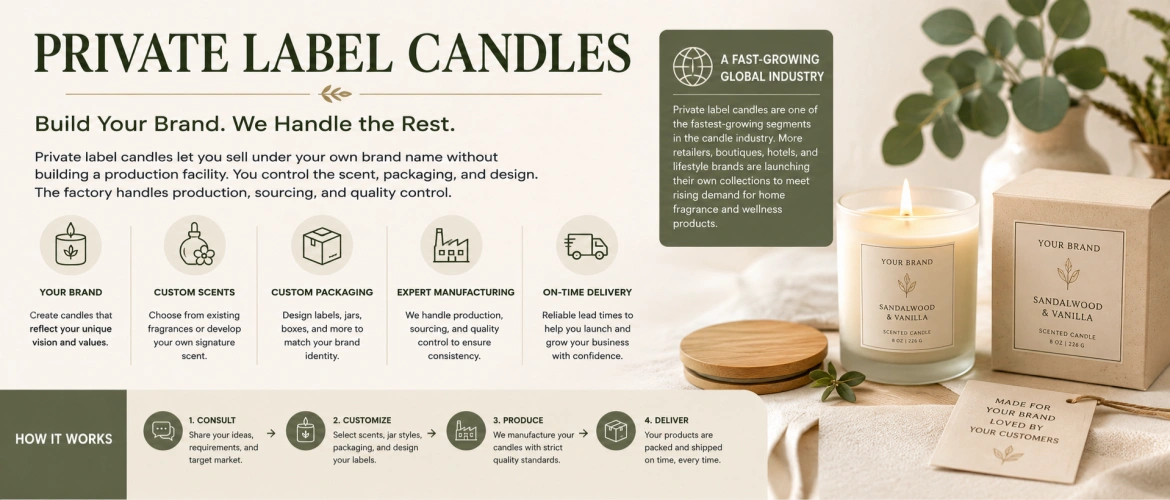
Private label candles are candles manufactured by a supplier and sold under your own brand. Depending on the level of customization, brands can select the candle vessel, fragrance, wax, wick, logo and packaging without operating their own candle factory.
At IGNITION, selected private label scented candle styles start from 50 pieces. We support stock and custom fragrances, logo printing, candle vessel customization, branded packaging, sampling, bulk production and international shipping. More complex OEM/ODM projects may require higher MOQs and longer development times.
Private Label Candle Quick Facts
| Item | IGNITION Private Label Service |
|---|---|
| MOQ | From 50 pcs for selected styles |
| Wax | Soy wax & custom wax blends |
| Fragrance | Stock & custom fragrances |
| Vessel | Glass, ceramic & metal |
| Wick | Cotton / wooden / multi-wick |
| Branding | Labels, screen printing, hot stamping, engraving |
| Packaging | Standard & custom packaging |
| Samples | Available |
| Production | 7–15 days for selected projects |
| Shipping | Air & sea |
| Main Markets | USA, Europe & worldwide |
Note: MOQ and lead time vary according to vessel, fragrance, printing method, packaging, quantity and level of customization.
What are private label candles and how do they work?
Private label is a manufacturing model. A candle producer makes the product for you. You put your name on it and sell it as your own. The factory stays invisible to your customers.
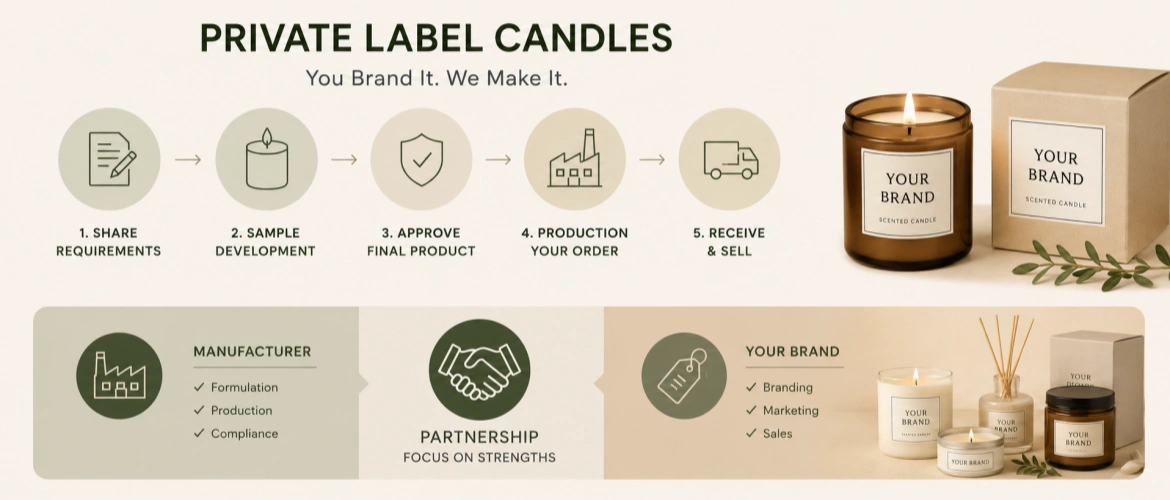
The process is straightforward. You share your requirements. The factory develops samples. You approve the final product. They produce your order. You receive and sell the finished goods.
In a private label arrangement, the manufacturer handles formulation, production, and compliance. You handle branding, marketing, and sales. It is a partnership where each side focuses on its strengths.
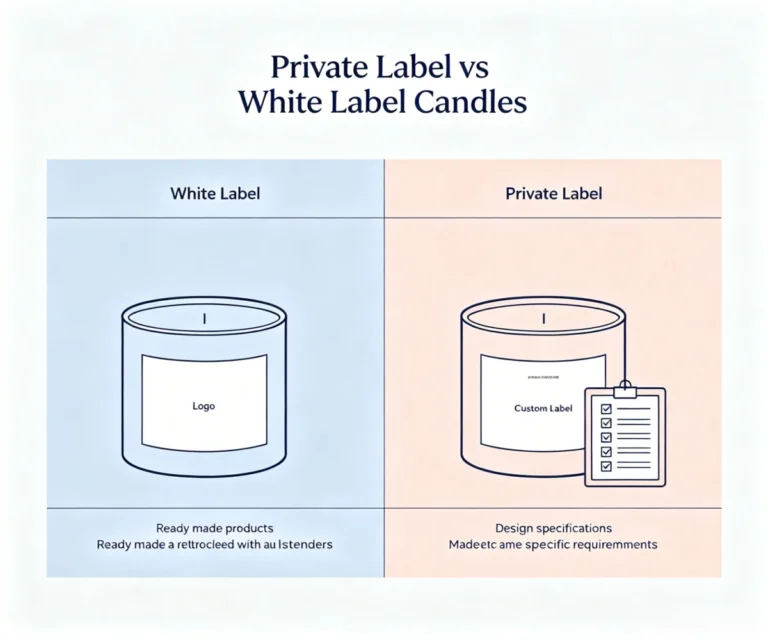
Private Label vs White Label vs OEM
| Model | How It Works | Customization | Typical Use |
|---|---|---|---|
| White Label | Existing product + your branding | Low | Fast launch |
| Private Label | Existing base product + customized brand elements | Medium | Brands & retailers |
| OEM | Manufactured according to your specifications | High | Established brands |
| ODM | Manufacturer provides product/design options for customization | Medium–High | Faster custom development |
How the Private Label Process Works
Step 1: Initial Consultation and Brief
You contact a candle manufacturer and explain your project.
- What you share: Your brand concept, target market, preferred scent profile, desired jar style, budget range, and target retail price.
- What the supplier asks: Volume estimates, timeline, any special requirements like organic wax, custom mold, or specific certifications.
- Outcome: The supplier gives you a preliminary quote and discusses feasibility.
Step 2: Product Development and Sampling
This is where your vision starts to take physical shape.
- Scent development: You choose from the supplier’s fragrance library or work with their perfumer to create a custom blend. The perfumer creates a small batch for you to test.
- Jar selection: You pick from catalog options or discuss custom mold possibilities.
- Wax and wick testing: The supplier tests different wax blends and wick sizes to optimize burn performance for your chosen jar and fragrance.
- Sample rounds: You receive samples. You test burn time, scent throw, and appearance. You request revisions until the product meets your standards.
- Timeline: 2–6 weeks, depending on complexity and revision rounds.
Step 3: Specification Finalization and Quotation
Once you approve the sample, everything goes into a document.
- What we finalize: Exact wax formula, fragrance load percentage, jar dimensions and material, wick type and size, label artwork, box design, packaging specifications.
- Quotation: The supplier provides a firm price based on your final specs and order quantity. This price includes raw materials, production, packaging, and any applicable certifications.
Step 4: Production
The factory orders materials and begins manufacturing.
- Lead time: Typically 4–8 weeks for standard private label orders. Custom molds or complex packaging add time.
- Communication: Reputable suppliers provide production updates and mid-production photos.
Step 5: Quality Control and Inspection
Before shipment, the finished goods undergo inspection.
- Supplier QC: The factory checks for defects, correct fill weight, proper labeling, and packaging integrity.
- Third-party inspection (optional): For large orders, you can hire an independent company to verify quality on your behalf.
Step 6: Shipping and Delivery
Your candles are packed and shipped to your warehouse or directly to your customers.
- Shipping method: Sea freight for large orders (cost-effective). Air freight for smaller urgent orders.
- Documents: Commercial invoice, packing list, bill of lading, and any required certificates (MSDS, IFRA, CE).
How Long Does Private Label Candle Production Take?
| Project Type | Typical Situation |
|---|---|
| Ready Stock | Fastest option |
| Stock Candle + Private Label | Selected projects: 7–15 days |
| Custom Packaging | Additional time may be required |
| Custom Fragrance | Sampling and testing required |
| Custom Vessel/Color | Longer material preparation |
| Fully Custom OEM | Timeline based on specifications |
A low-MOQ private label project using an existing candle vessel, available fragrance and custom label can be completed much faster than a fully customized OEM project.
At IGNITION, selected private label projects can be completed in approximately 7–15 days after specifications and samples are confirmed. Custom fragrances, custom-colored vessels, special packaging or newly developed components require additional development and production time.
How can brands customize scents and packaging?
Customization is the core value of private label. It is what separates your brand from a generic white label product. The degree of customization depends on your budget and volume.
You can customize almost every aspect of a candle. The most impactful areas are the fragrance, the vessel, and the outer packaging. Each element contributes to your brand identity and customer experience.
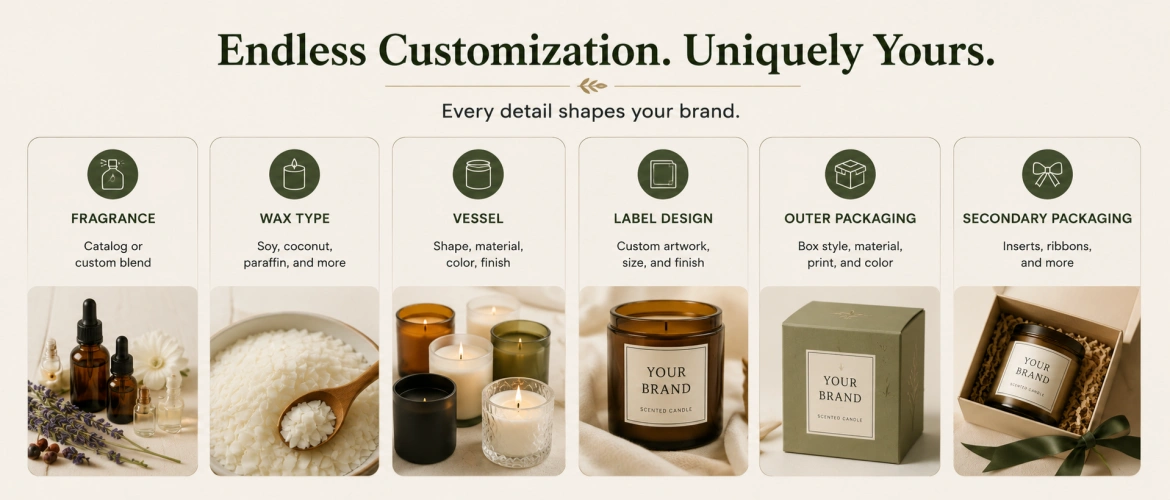
Private label brands can customize fragrance (catalog or custom blend), wax type, jar shape and material, label design, box construction, and secondary packaging like inserts and ribbons.
What Can You Customize?
1.Fragrance
Choose from our existing fragrance collection, adjust an existing fragrance direction, or discuss custom fragrance development for larger customized projects.
2. Wax
Soy wax and different wax formulations can be selected according to candle design, fragrance performance and project requirements.
3. Candle Vessel
Available options include glass, ceramic and metal vessels in different sizes, colors and finishes.
4.Wick
Cotton, wooden and multi-wick configurations can be selected according to vessel size and candle design.
5.Logo & Branding
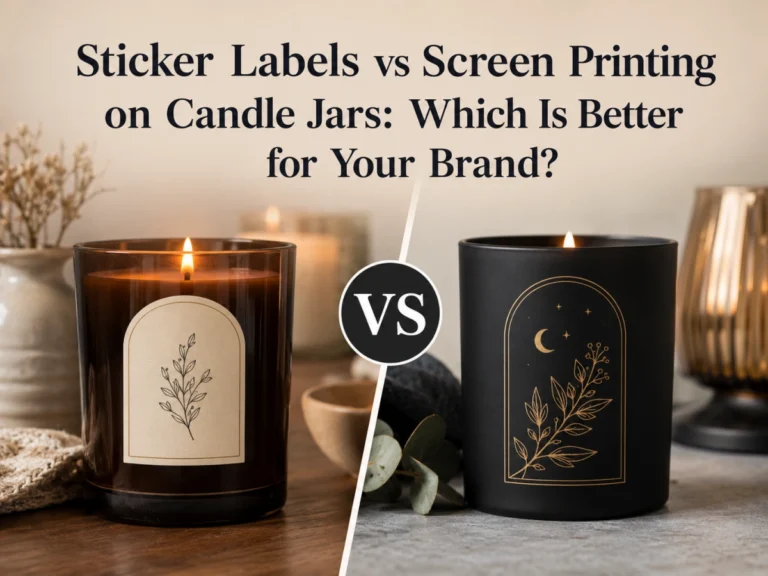
Branding options include adhesive labels, screen printing, hot stamping, laser engraving and other decoration methods.
6.Packaging
Packaging options include standard boxes, rigid gift boxes, magnetic boxes, cylinder boxes, kraft packaging and customized packaging solutions.
Customization Level Comparison
| Element | Basic (Catalog) | Intermediate (Modified) | Advanced (Custom) |
|---|---|---|---|
| Scent | Choose from catalog | Modify existing scent | Develop custom accord |
| Wax | Supplier’s standard | Specify wax type | Custom blend |
| Jar | Stock jar | Colored/frosted/etched | Custom mold |
| Label | Your artwork on stock label | Custom shape/size | Printed directly on jar |
| Box | Standard box with your print | Custom size/material | Fully custom design + finishes |
Start with what fits your budget. As your brand grows, upgrade to deeper customization levels for your best-selling SKUs.
What Is the MOQ for Private Label Candles?
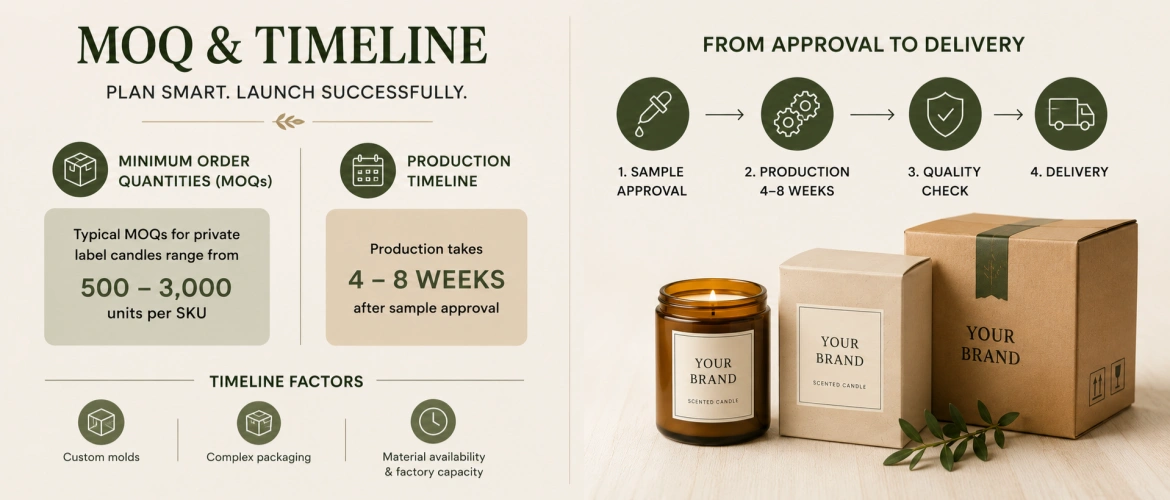
Private label candle MOQ depends on how much of the product needs to be customized. Using an existing candle vessel, fragrance and packaging structure usually allows a lower MOQ than developing a custom fragrance, vessel or packaging component.
| Project | MOQ |
|---|---|
| Selected In-Stock Candles | From 50 pcs |
| Selected Private Label Candles | From 50 pcs/SKU |
| Standard Customization | Depends on product |
| Custom Fragrance | Project dependent |
| Fully Custom Vessel | Higher MOQ required |
Why can some private label candles start from 50 pieces?
Why do fully customized candles require higher MOQs?
Custom-colored vessels, exclusive fragrances, custom molds and specialized packaging may have separate material or supplier minimums. These requirements can increase the final production MOQ.
What Affects Production Lead Time?
| Factor | Effect on Lead Time |
|---|---|
| Stock vessel | Faster |
| Existing fragrance | Faster |
| Adhesive label | Faster |
| Custom fragrance | Additional development |
| Custom-colored vessel | Additional preparation |
| Custom packaging | Additional production |
| Custom mold | Longest development |
| Large quantity | Depends on production schedule |
Tips for Managing Production Smoothly
- Confirm material availability before placing the order. Ask the supplier if all components (jars, fragrance oils, boxes) are in stock or have confirmed delivery dates.
- Plan around peak seasons. Chinese factories are very busy from August to October (holiday orders). European factories slow down in August (summer holidays). Book your production slot early.
- Allow curing time. Candles need 1–2 weeks after pouring for the fragrance to fully bind with the wax. Rushing this step results in weaker scent throw.
- Request a production schedule. A good supplier provides a timeline with key milestones (material arrival, production start, QC date, estimated completion).
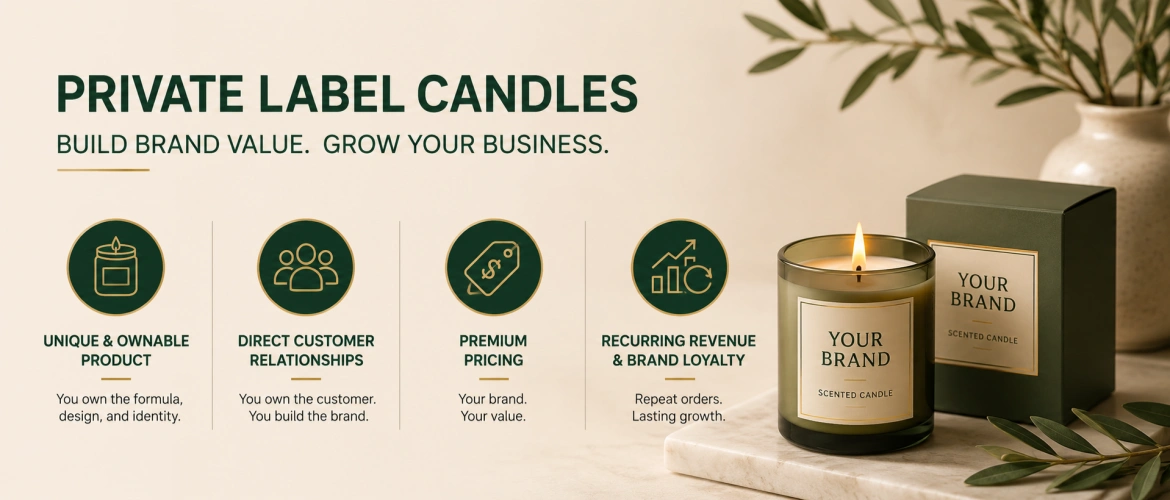
How do private label candles help build brand value?
Brand Differentiation
Unique fragrance, packaging and visual identity help distinguish your candle collection.
Pricing & Positioning
Customized products allow brands to build different retail positioning instead of competing only on generic products.
Product Expansion
Once the first collection is validated, brands can expand into new fragrances, vessel sizes, seasonal collections and gift sets.
Private Label vs Fully Custom
Which Candle Manufacturing Option Should You Choose?
| Requirement | Recommended Option |
|---|---|
| Test a new brand with 50–100 pcs | Private Label |
| Add logo to existing candle | Private Label |
| Launch quickly | Private Label |
| Choose several stock fragrances | Private Label |
| Custom packaging | Private Label / OEM |
| Develop exclusive fragrance | Custom / OEM |
| Custom vessel color | OEM / ODM |
| Develop unique vessel mold | Full OEM |
| Large branded collection | OEM / ODM |
Factory Example
Example: Low-MOQ Private Label Candle Project
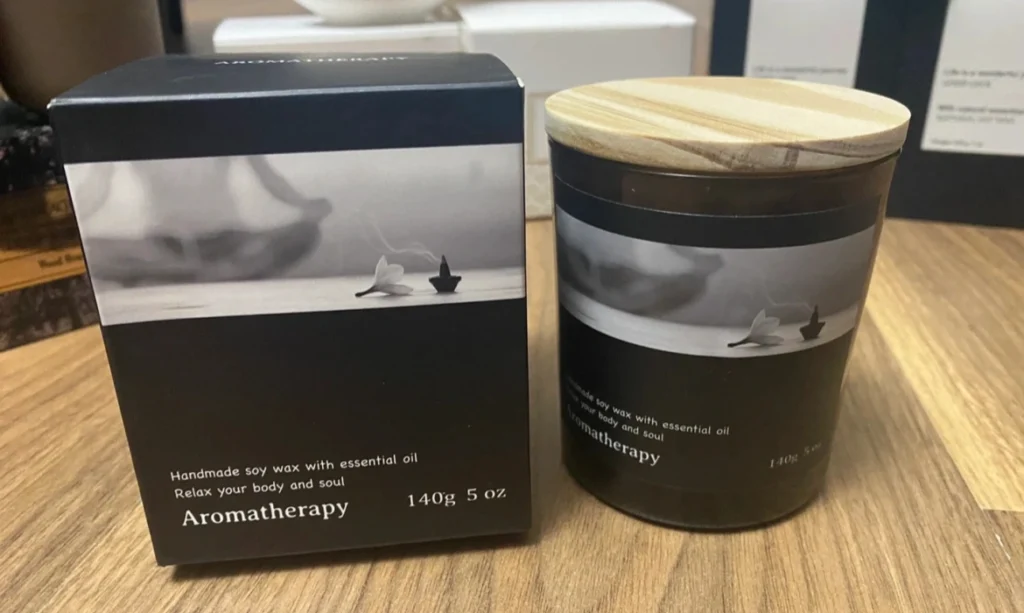
A brand that wants to test the market can start with an existing 5 oz or 7 oz candle vessel, select available fragrances and apply its own label. For selected styles, the private label MOQ starts from 50 pieces.
This approach avoids the higher material minimums associated with custom molds, exclusive vessel colors and fully customized packaging.
View Low-MOQ Private Label Candles →
Can You Order Samples Before Bulk Production?
Yes. Samples are recommended before bulk production, especially when fragrance, branding, candle vessels or packaging are customized. Sampling allows you to evaluate important product details before confirming a larger order and helps reduce the risk of unexpected differences during mass production.
At IGNITION, we offer different sample options depending on the stage and requirements of your private label candle project.
Fragrance Samples
Fragrance samples are suitable when you want to evaluate and compare scents before selecting fragrances for your candle collection.
They are especially useful if you are choosing between several fragrance directions, such as floral, woody, fruity, fresh or gourmand scents.
For fragrance evaluation, we can provide small fragrance candle samples so you can compare different scent options before confirming the final fragrance selection.
If your project requires an exclusive custom fragrance, additional fragrance development, adjustment and testing may be required before the scent is approved for candle production.
Stock Product Samples
Stock product samples are recommended when you want to evaluate an existing candle before placing a private label order.
A stock sample allows you to check important product details such as:
- Candle vessel size and appearance
- Wax color and surface finish
- Fragrance
- Wick configuration
- Candle weight
- Packaging
- Overall product quality
This is usually the fastest and most cost-effective sampling option for brands planning to start with one of our existing candle styles.
After evaluating the sample, you can select the preferred candle, fragrance and branding options for your private label order.
Custom Samples
For projects involving custom branding or packaging, we can prepare a customized sample before bulk production.
Depending on the project, the sample can be used to confirm:
- Logo size and placement
- Adhesive label design
- Screen printing or other decoration
- Candle vessel color and finish
- Fragrance
- Custom packaging
- Gift box design
- Overall branded appearance
Custom samples are particularly useful for OEM and ODM projects where several product elements need to be confirmed before mass production.
Why Is Sampling Important?
A candle may look different in a digital mockup than it does as a finished physical product. Fragrance performance, label proportions, vessel finishes, packaging materials and printing effects are also easier to evaluate with an actual sample.
For this reason, sampling provides an important confirmation stage between product development and bulk production.
For customized projects, we recommend confirming the key specifications before mass production begins.
What Happens After the Sample Is Approved?
Once the sample and important product specifications are confirmed, we finalize the requirements for bulk production.
These may include:
Candle vessel → Wax → Fragrance → Wick → Logo → Label/Printing → Packaging → Quantity
Bulk production can then proceed according to the approved specifications.
Production lead time depends on the candle style, quantity and level of customization. Selected private label projects can typically be completed in approximately 7–15 days after the specifications and sample are confirmed, while fully customized OEM/ODM projects may require additional time.
Ready to Request a Candle Sample?
Tell us the candle style, fragrance, quantity, branding requirements and packaging preferences you are interested in. Our team can recommend the most suitable sample option before you move forward with bulk production.
What Information Should You Send a Candle Manufacturer?
To receive an accurate quotation and suitable product recommendation, it helps to provide your candle manufacturer with the basic requirements of your project.
You do not need to have every detail finalized before contacting us. Even if you only have a general product idea, the information below can help us understand your project and recommend suitable candle styles, customization options and production solutions.
1. Candle Style and Size
Tell us what type of candle you are looking for, such as a glass jar candle, ceramic candle, tin candle, multi-wick candle or candle gift set.
If you already know the preferred size or wax weight, include that information as well, for example:
7 oz glass scented candle
8 oz ceramic candle
3-wick candle
If you are unsure about the size, you can also send us a reference photo or describe the style you want.
2. Estimated Order Quantity
Provide your estimated quantity, such as 50, 100, 500 or 1,000 pieces.
Order quantity affects product pricing, customization options, packaging costs and shipping methods.
For selected private label candle styles, our MOQ starts from 50 pieces. More customized OEM/ODM projects may require higher quantities depending on the vessel, fragrance, branding and packaging requirements.
3. Number of Fragrances
Let us know how many fragrances you would like in your candle collection.
You can choose from available fragrances or discuss custom fragrance development if you want to create a more distinctive scent for your brand.
If you have not selected your fragrances yet, simply tell us the scent direction you prefer, such as:
Floral / Woody / Fresh / Fruity / Gourmand / Amber / Musk / Oud
We can then recommend suitable fragrance options.
4. Preferred Wax
If you have a preferred wax type, include it in your inquiry.
Depending on the candle and project requirements, options may include soy wax or different wax blends.
If you are unsure which wax is suitable, we can recommend an option based on the candle vessel, fragrance and desired performance.
5. Logo and Artwork
If you already have a logo, label design or other brand artwork, send the file together with your inquiry.
Depending on the candle vessel and design, branding options may include:
Adhesive labels, screen printing, hot stamping, laser engraving and other decoration methods.
If your artwork is not ready yet, you can still request a quotation first.
6. Packaging Requirements
Tell us whether you need standard packaging or customized branded packaging.
For example:
Individual box / Rigid gift box / Magnetic box / Cylinder box / Kraft box / Candle gift set
If you have a packaging reference or design concept, sending an image can help us understand the desired style more accurately.
7. Delivery Destination
Please provide the destination country and ZIP/postal code if you would like us to estimate shipping costs.
For example:
United States, ZIP Code 30301
The destination helps us evaluate suitable shipping options and provide a more accurate landed-cost estimate when applicable.
8. Target Delivery Time
If your candles are required for a specific launch date, holiday, event or retail season, let us know your preferred delivery date.
This is especially important for Christmas, Valentine’s Day, Mother’s Day, corporate gifts and other seasonal projects, as additional time may be required for sampling, production and international shipping.
Private Label Candle Inquiry Checklist
Before requesting a quote, prepare as much of the following information as possible:
| Information | Example |
|---|---|
| Candle Style | Glass jar candle |
| Size | 7 oz |
| Quantity | 200 pcs |
| Fragrances | 4 scents |
| Wax | Soy wax |
| Branding | Custom logo label |
| Packaging | Individual gift box |
| Destination | USA + ZIP code |
| Target Delivery | December 1 |
Don’t have all the details yet? That’s okay. Send us your preferred candle style, approximate quantity and destination, and our team can help you determine the remaining specifications.
Ready to Request a Quote?
Send us your candle style, quantity, fragrance preferences, branding requirements, packaging needs and delivery destination. We can then recommend a suitable private label or OEM/ODM solution for your project.
Conclusion
Private label candles provide a flexible way for brands to launch and expand candle collections without operating their own manufacturing facility. The right production model depends on your quantity, fragrance, vessel, branding and packaging requirements.
At IGNITION, selected private label candle styles start from 50 pieces, while more customized OEM/ODM projects may require higher MOQs and longer development timelines. Starting with an existing vessel, available fragrance and custom branding is usually the most efficient route for smaller or first-time orders.
Before requesting a quote, prepare your preferred candle style, quantity, fragrance direction, branding requirements, packaging needs and destination. This allows the manufacturer to recommend the most suitable production solution.