Scented Candle Manufacturer & Supplier

Private Label vs White Label Candles: What’s the Difference?
You want to launch your own candle line. Suppliers offer “private label” and “white label” options. The terms sound alike, but they are not the same. Picking the wrong one can limit your brand or waste your budget.
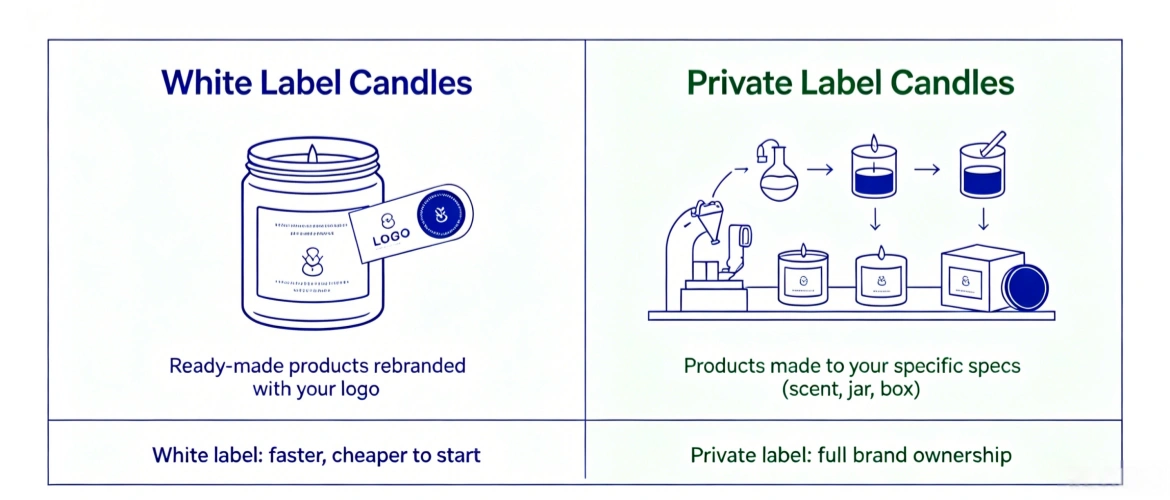
White label candles are ready-made products you rebrand with your logo. Private label candles are made to your specs—from scent to jar to box. White label is faster and cheaper to start; private label gives you full brand ownership.
This guide explains the difference, compares customization and cost, and helps you pick the right model for your goals.
How do private label candles differ from white label?
You need to know exactly what you are buying. A white label candle is a finished product in a warehouse. You just add your sticker. A private label candle is built around your brand, often with exclusive elements.
The biggest difference is control. In white label, the factory picks the formula. In private label, you do.
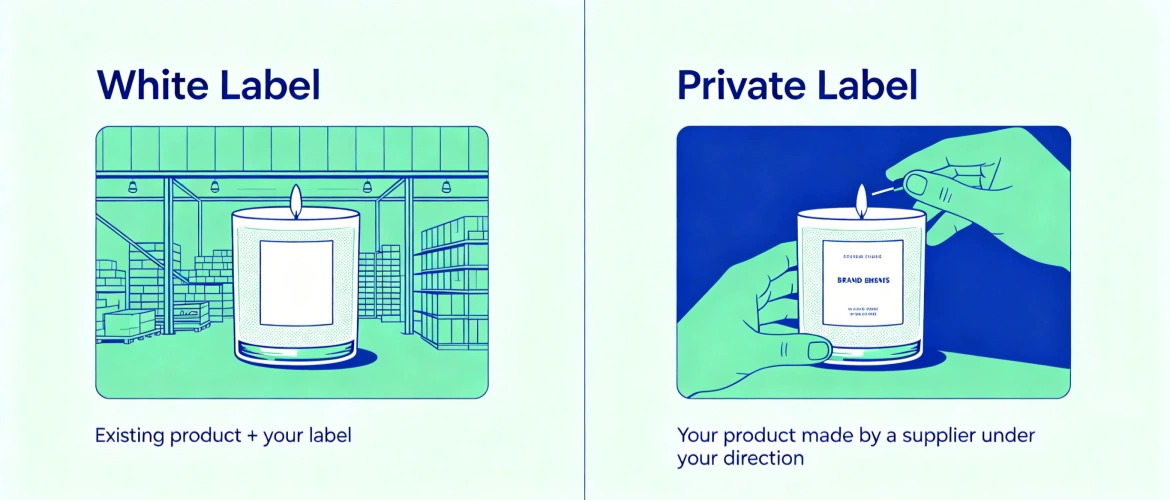
White label = existing product + your label. Private label = your product made by a supplier under your direction.
Defining Each Model
White Label (Stock Label)
The factory makes candles in standard jars with standard scents—for example, an 8oz soy candle in “Clean Cotton.” Many brands can buy the exact same candle.
- You get: The candle plus the right to apply your own label or box.
- You cannot change: The wax blend, fragrance oil, jar shape, or wick.
- Think of it as: Buying a plain t-shirt and printing your logo on it. The shirt style is fixed.
Private Label (Custom / OEM)
You work with the factory to create a candle that fits your brand. This ranges from small tweaks to full development.
- You get: A candle with your exclusive scent, custom wax blend, custom jar, wick sizing, and full packaging design. The factory usually agrees not to sell that exact version to others.
- You control: Scent profile, wax type (coconut-soy, pure soy, etc.), jar material/shape/color, label, box, burn time targets.
- Think of it as: Hiring a tailor to make a suit to your exact measurements and fabric choice.
Quick Comparison
| Aspect | White Label | Private Label |
|---|---|---|
| Product Origin | Pre-existing factory design | Made to your specifications |
| Scent | From factory catalog | Can be custom-blended |
| Jar / Packaging | Standard catalog options | Custom mold or exclusive design OK |
| Exclusivity | None | Usually yes (by contract) |
| MOQ | Low (100–300 units) | Higher (500–2,000+ units) |
| Time to Market | 1–3 weeks | 6–14 weeks |
In short: Want speed and low risk? Choose white label. Want a unique product no one else can copy? Choose private label.
Which option offers more customization for brands?
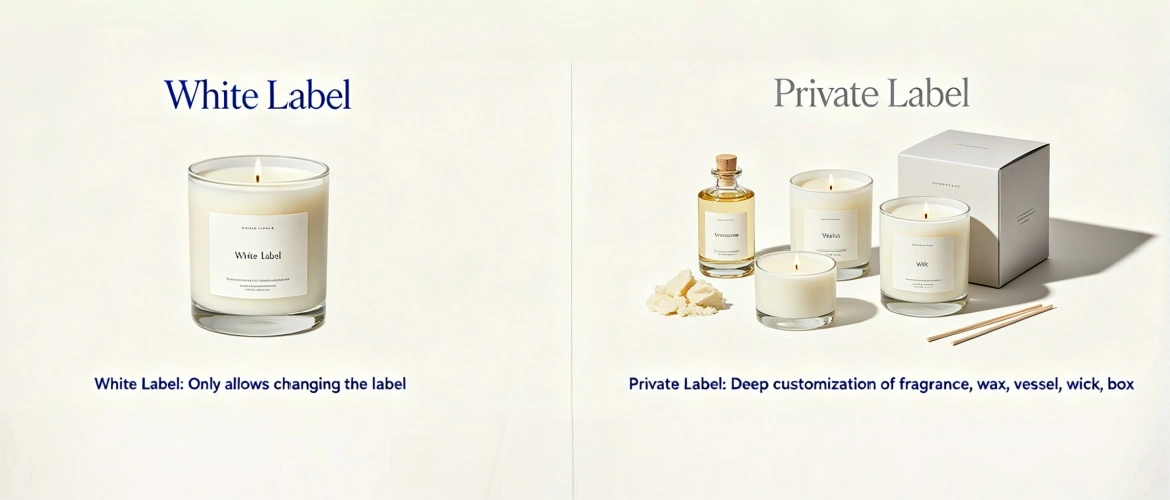
Customization is why brands pick private label. White label only lets you change the label. Private label can go deep—fragrance, wax, vessel, wick, and box.
The more you customize, the more your candle becomes a real brand asset. Exclusive scents and jars let you charge premium prices and build loyalty.
Private label offers deep customization—exclusive fragrances, custom jars, unique wax blends, tailored packaging. White label allows only surface branding (your label on a standard product).
What Each Model Allows
White Label Scope
You can usually:
- Pick from existing scents (e.g., Vanilla, Sea Salt, Lavender).
- Pick from standard jars (clear glass, amber, black tin, etc.).
- Apply your printed label, hang tag, or plain box with your sticker.
You cannot change the scent formula, jar shape, wax type, or wick.
Private Label Scope
Depending on your supplier, you can:
- Scent Customization
- Slightly adjust a catalog scent (more musk, less citrus).
- Develop a brand-new accord with the supplier’s perfumer (e.g., “Moroccan Mint Tea” or “Old Library Leather”).
- Set fragrance load (typically 8–12%) for desired hot/cold throw.
- Wax & Wick
- Specify wax: 100% soy, coconut-soy blend, beeswax blend, or vegan blend.
- Have wicks sized through burn testing for your jar and fragrance.
- Vessel
- Choose from extended catalog (matte ceramic, colored glass, concrete).
- Commission a custom jar mold unique to your brand (higher cost, true exclusivity).
- Add embossed logos on the jar or dust covers.
- Packaging
- Fully custom box: die-cut shape, soft-touch lamination, foil stamping, embossing.
- Include brand story cards, care instructions, QR codes.
- Use FSC-certified board and soy inks for sustainability.
If your brand promises an exclusive signature scent or unique vessel, you need private label. If you’re testing market reaction with a proven concept, white label gets you there faster.
How do costs and MOQ compare between the two?
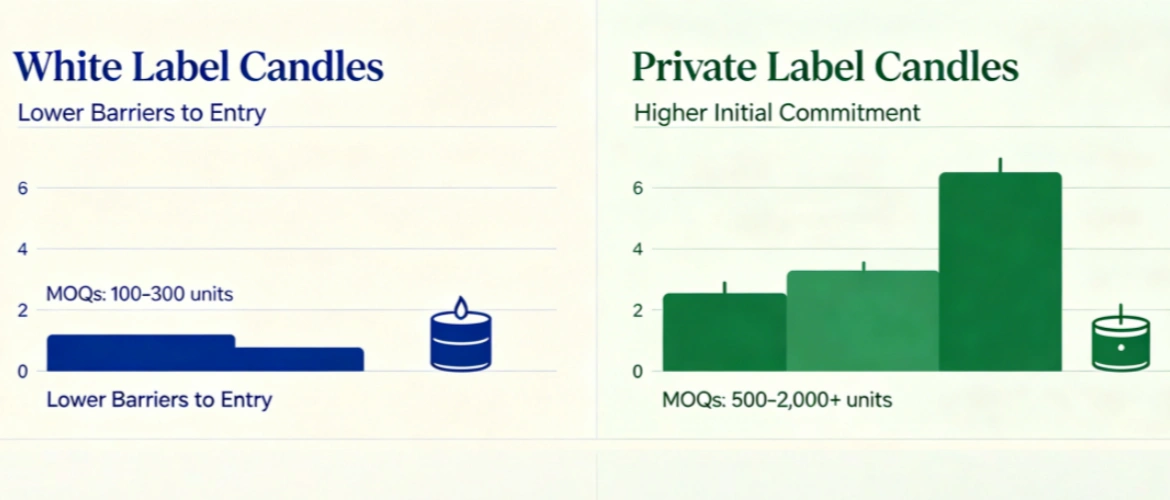
Budget and order size usually decide. White label has low barriers. Private label needs more commitment upfront but gives better long-term value for growing brands.
There is no fixed price, but the pattern is clear: white label costs less to start; private label costs more to develop but can lower unit price at scale.
White label has lower MOQs (often 100–300 units) and no development fees. Private label has higher MOQs (500–2,000+ units) and may include one-time mold or scent fees, but offers exclusivity and better margins at volume.
The Numbers
White Label Cost Structure
- MOQ: 100–500 units per scent/jar combo.
- Development Fee: $0.
- Unit Price Example: Standard 8oz soy candle = $4.50–$6.50 (depends on jar/label).
- Time to Market: 1–3 weeks.
This lets you launch with minimal capital and low risk.
Private Label Cost Structure
- MOQ: 500–2,000 units per SKU (some offer 300–500 with light customization).
- Possible Fees:
- Custom scent development: $200–$800 (often waived at higher volumes).
- Custom jar mold: $3,000–$8,000+ (amortized over first order).
- Unit Price Example: Same 8oz custom candle = $3.80–$5.50 at 1,000+ units.
- Time to Market: 6–14 weeks (develop → sample → approve → produce → ship).
Cost & MOQ Summary
| Factor | White Label | Private Label |
|---|---|---|
| MOQ per SKU | 100–500 | 500–2,000 |
| Dev. Fee | $0 | $0–$8,000+ (if new mold/scent) |
| Unit Price (8oz soy) | $4.50–$6.50 | $3.80–$5.50 (at volume) |
| Exclusivity | No | Yes |
| Launch Speed | Fast | Slower |
Many brands start white label to test the market, then move top-selling SKUs to private label once they have data and steady reorders. This hybrid approach spreads risk.
Which model suits different B2B business goals?
There is no single right answer—only what fits your stage and ambition. Ask: Am I testing an idea, building a brand asset, or supplying corporate gifts?
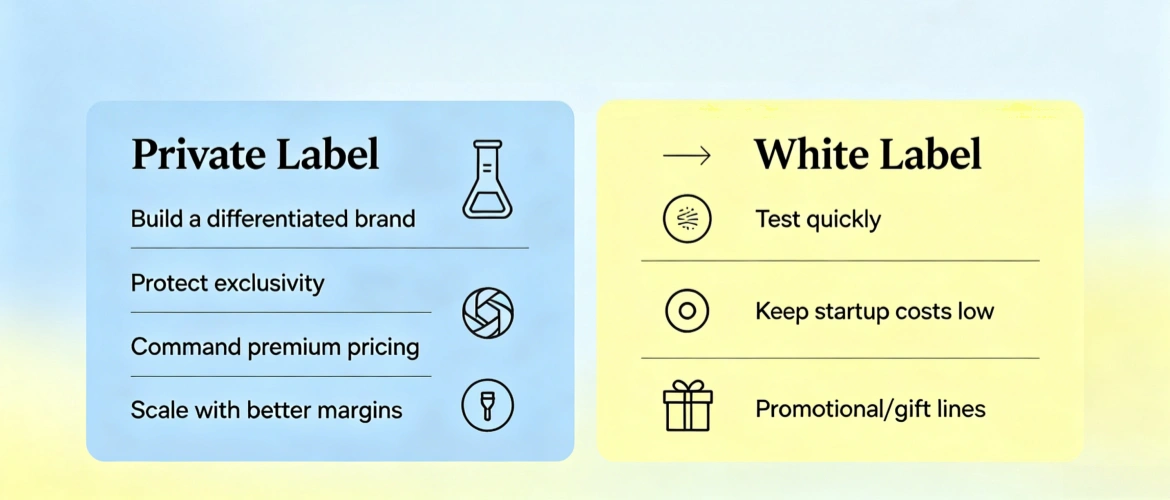
Choose white label to test quickly, keep startup costs low, or for promotional/gift lines. Choose private label to build a differentiated brand, protect exclusivity, command premium pricing, and scale with better margins.
Matching Model to Scenario
New Brand / Market Testing → White Label
You have a logo and vision but limited funds. Low MOQ lets you order 200 candles across 3 scents, see what sells, and build social proof before a bigger investment. Later, move winners to private label.
Premium Brand Building → Private Label
You have funding or an audience. You need an exclusive scent (“Oud & Fig Leaf”) and a custom matte black jar with your logo debossed. This can’t be copied, justifies higher retail pricing ($48–$68+), and builds brand IP.
Corporate Gifts / Hotel Amenities → White Label (or Light Private Label)
A hotel wants 1,000 candles with their logo for guest kits. No new scent needed—just their branding on a proven product. A “light PL” option (stock candle + custom-printed box in their Pantone color) feels more premium but keeps MOQ low and turnaround fast.
Scaling an Existing Brand → Private Label (Cost Optimization)
You reliably reorder 500 units/month of one SKU. Committing to 1,000+ units can drop your unit cost (e.g., $5.20 → $4.40). Over a year, those savings fund your next launch. You also lock in exclusivity.
Decision Guide
| Your Priority | Recommended Model |
|---|---|
| Fastest launch, lowest cash risk | White Label |
| Validate market before investing | White Label → transition top SKUs |
| Unique, ownable product (scent/vessel) | Private Label |
| Premium positioning & higher price | Private Label |
| Corporate gift / promo with logo only | White Label (custom box OK) |
| Improve margin at proven volume | Private Label (volume commitment) |
Don’t feel locked in. The smartest B2B candle programs evolve—start where you are, prove the concept, then graduate to deeper customization as you grow.
Conclusion
White label and private label serve different needs. White label gets you to market fast with low risk—perfect for testing and gifting. Private label builds a unique, defendable brand with exclusive scents and vessels—ideal for premium positioning and long-term growth.
Choose white label to start lean. Choose private label to own your product. Most successful brands use both at different stages.