Private Label Scented Candle Manufacturer in China | IGNITION


Private Label Candle Manufacturer vs Trading Company: Which Choose?
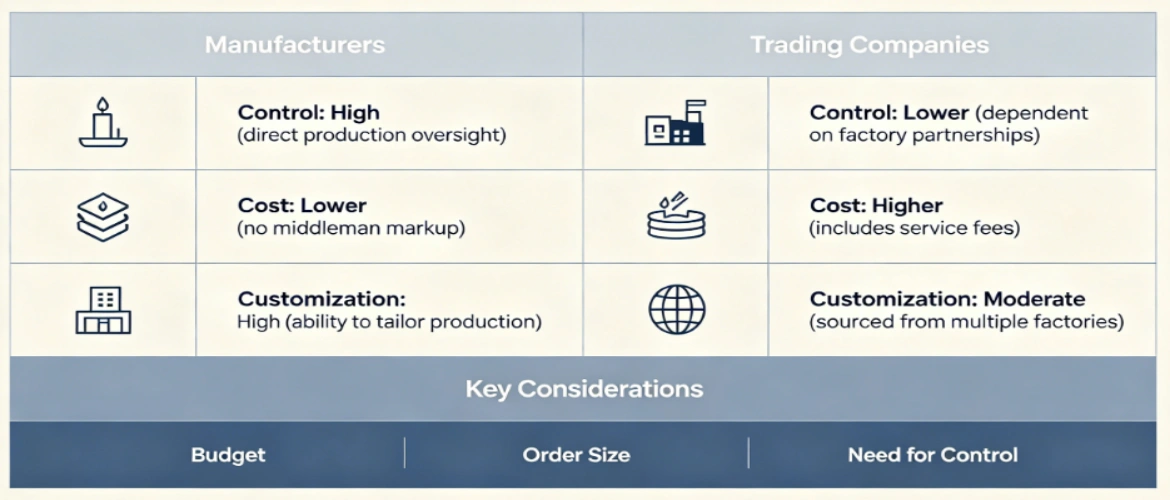
You want to launch a private label candle line, but you’re unsure which partner to choose. You see options from both Private Label Candle Manufacturer and trading companies. Each has its own strengths, yet choosing the wrong one could negatively impact your brand.
Manufacturers make the products themselves. Trading companies act as middlemen, sourcing products from different factories. Your best choice depends on your budget, order size, and need for control.
Let’s break down the key differences. We will compare control, cost, and customization to help you make a clear decision.
What are the advantages of working with Private Label Candle Manufacturer?
You want full control and the best price. You need to know if a factory is the right partner. Many buyers go straight to a manufacturer for this.
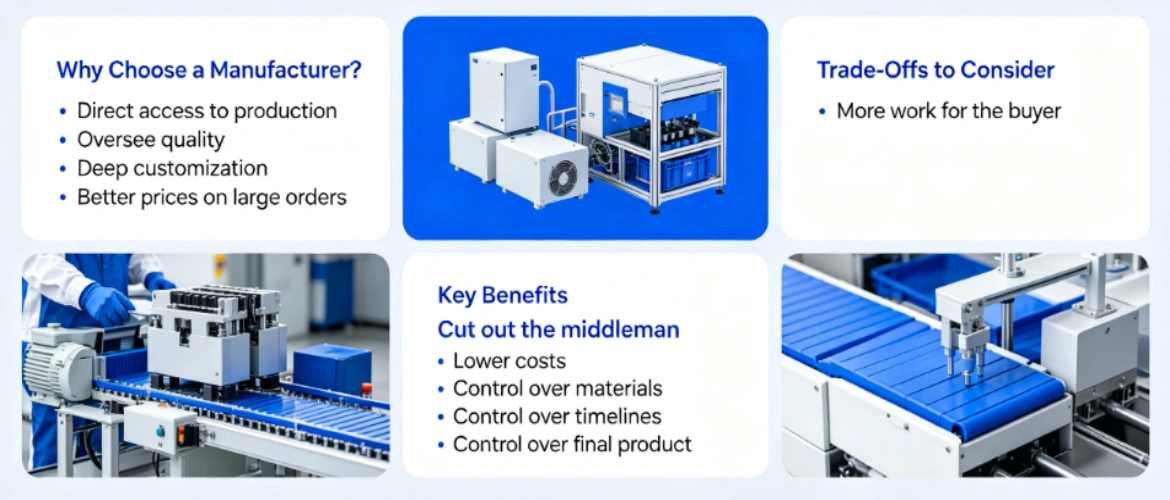
Working with a Private Label Candle Manufacturer gives you direct access to production. You can oversee quality, customize deeply, and get better prices on large orders. But it also means you take on more work.
Direct partnerships with manufacturers cut out the middleman. This lowers costs and gives you more control over materials, timelines, and the final product.
The Realities of Factory Partnerships
When you work with a candle factory, you deal with the source. This has clear benefits, but it’s not always simple.
You Get More Control
The biggest advantage is control. You speak directly to the team that makes the candles.
- You choose the materials. You pick the exact wax type, fragrance strength, and jar quality.
- You set quality standards. Factories can send you batch samples and production photos. For big orders, you can even visit.
- You solve problems faster. If something is wrong, you fix it with the people who can change it immediately. There is no third party to slow things down.
The Cost: Lower Price, More Work
People think factories are always cheaper. This is often true, but you need to see the full picture.
| Cost Factor | Manufacturer | Trading Company |
|---|---|---|
| Price Per Candle | Usually lower. You skip the middleman’s fee. | Higher. The price includes the trader’s service fee. |
| Setup Fees | You might pay for custom molds or scent development. | These costs are often bundled into a service fee. |
| Order Minimums | Can be high, especially for custom items. | Can be more flexible. Traders combine orders to meet minimums. |
| Hidden Work | You manage shipping, quality checks, and import papers. | The trading company often handles these services. |
The trade-off is clear. You get a lower price per candle, but you do more work. For a big brand, this makes sense. The savings on 10,000 candles are huge. For a small startup, managing everything can be too much.
The Communication Challenge
Talking directly to a factory can be hard. There may be language gaps and time zone differences. Your emails need to be very clear. A trading company in your region often provides smoother communication.
In short, choose a manufacturer if you have large orders, some experience, and time to manage details. You trade your effort for control and lower cost.
How do trading companies differ in service and pricing?
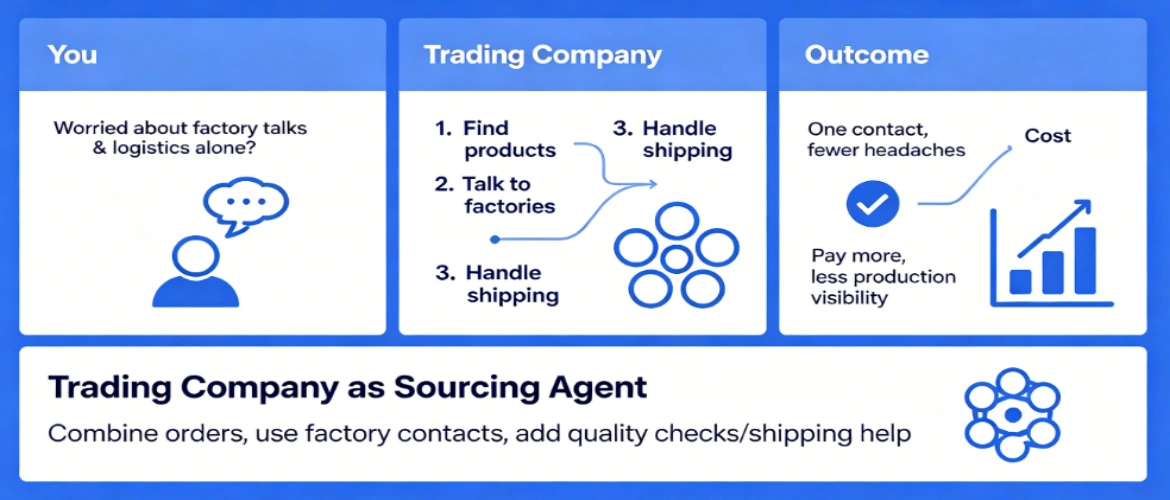
You want an easier process. You’re not sure you can handle factory talks and logistics alone. Trading companies promise less hassle, but you worry about higher cost and less control.
Trading companies simplify buying. They find products, talk to factories, and handle shipping. You have one contact and fewer headaches, but you pay more and see less of the production.
Trading companies are your sourcing agent. They combine orders from many buyers, use their factory contacts, and add services like quality checks and shipping help.
The Value of a Middleman
Calling them just a “middleman” is too simple. A good trader provides services that solve real problems.
The Service Bundle
When you buy from a trader, the higher price pays for services.
- They find and check factories. They reduce your risk by vetting suppliers.
- They manage communication. They explain your needs to the factory and get updates for you.
- They do quality checks and combine orders. They can inspect goods and ship different products together, saving freight cost.
- They handle logistics. They arrange shipping and customs papers, which is a big task removed for you.
The Price: Convenience Costs More
Let’s compare the pricing models.
| Service Aspect | With a Trading Company | Direct with Manufacturer |
|---|---|---|
| Final Price | Higher. Includes the trader’s profit. | Lower. You pay the factory cost plus your logistics. |
| Payment Terms | Often more flexible. May offer credit. | Usually strict. Factories want deposits upfront. |
| Order Flexibility | Better. You can mix smaller orders of different items. | Worse. You must meet the factory’s minimum for each custom item. |
| Your Risk | Lower. The trader shares the supplier risk. | Higher. You carry all the factory risk yourself. |
Think of it this way. Going direct to the factory is like cooking a big meal from scratch. Using a trader is like hiring a chef. You pay more, but you save time and avoid mistakes.
The Potential Downsides
The main risk is less transparency. You are not at the factory. If quality is bad, you must go through the trader first. Also, some traders are not good. They just take orders without real skill.
Choose a trading company if your time is valuable, your order is complex or small, or you are new to importing. You pay for ease, knowledge, and less risk.
Which option offers better customization flexibility?
Your brand vision is clear. You’re looking for unique scents and custom jars. What you need is a partner who can bring your ideas to life—without heavy constraints.
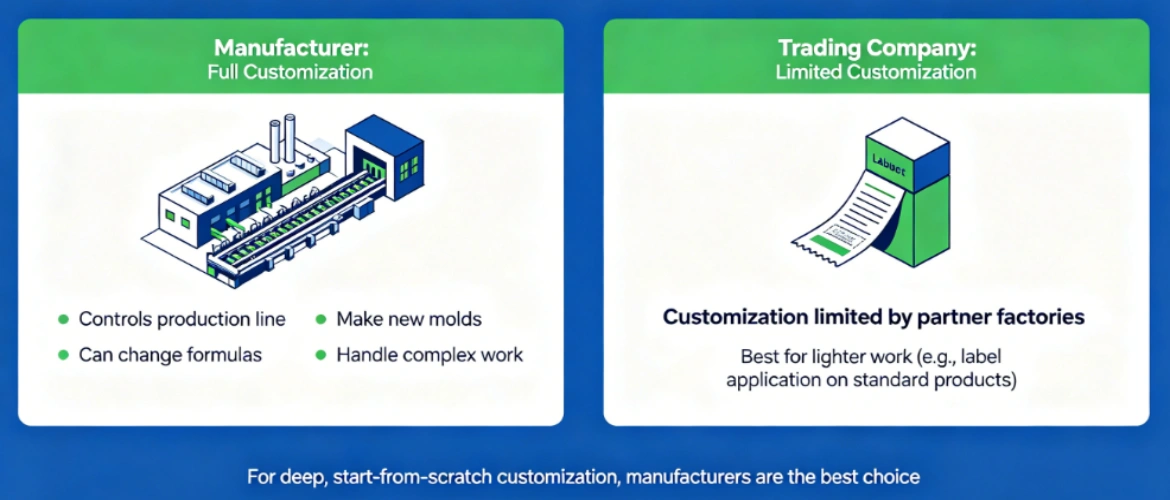
For deep, start-from-scratch customization, manufacturers win. They control the production line. They can change formulas, make new molds, and do complex work. Trading companies can customize, but only as much as their partner factories allow.
True customization needs a Private Label Candle Manufacturer. Think exclusive scents or new jar shapes. Trading companies are better for lighter work, like putting your label on a standard product.
The Layers of Customization
Customization has levels. Your needs decide your best partner.
Level 1: Private Label
You pick a standard candle and add your logo.
- Manufacturer: Can do this. Needs a moderate order minimum.
- Trading Company: Excels here. Good for market testing.
Level 2: Mix and Match
You choose from existing options: Jar A, Wax B, Scent C, plus your label.
- Manufacturer: Very capable. They control the parts.
- Trading Company: Can do this if their factory partner allows it.
Level 3: Create Something New
You want a new jar shape or a never-made fragrance.
- Manufacturer: This is their strength. You work with their experts. You pay for development, but you own the design. Order minimums are high.
- Trading Company: Very limited. Most can’t do this. They lack the in-house skill.
Customization Comparison
| Customization Task | Best Partner | Key Reason |
|---|---|---|
| Make a new fragrance oil | Manufacturer | Needs a perfume lab and direct access. |
| Design a unique jar mold | Manufacturer | Needs factory engineering and tooling. |
| Put your label on 3 jar styles | Trading Company | They can source jars and manage labeling from multiple places. |
| Change the fragrance strength | Manufacturer | Needs a direct change to the production formula. |
| Make a gift set with a candle and matches | Trading Company | They can source different items and combine them. |
The simple rule: If you are mostly choosing and combining existing parts, a trading company can work. If you are inventing new parts, you need a Private Label Candle Manufacturer. For a unique brand, the manufacturer path is a must.
How can buyers choose the right business partner?
You see the differences now. You need a simple way to pick the right partner for your business today. A wrong choice wastes money and time.
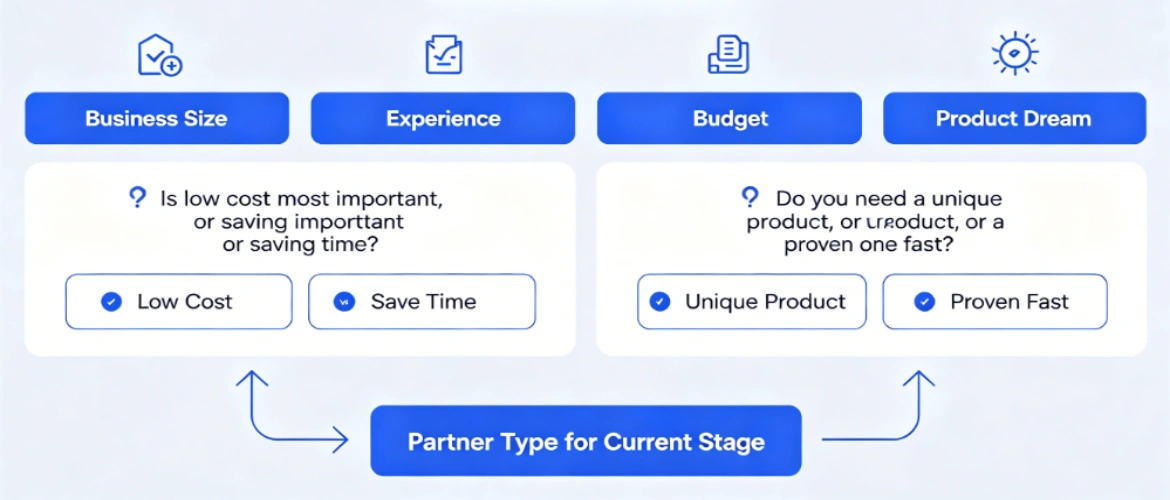
Your choice depends on your business size, experience, budget, and product dream. Use a clear framework to decide what you need now.
Ask yourself: Is low cost most important, or is saving time? Do you need a unique product, or a proven one fast? Your answers point to the right partner type for your current stage.
A Decision Framework
Let’s make a practical guide. Ask these questions.
Step 1: Check Your Business Stage & Order Size
Your order volume filters the options first.
- Startup / Testing (100 – 500 units): You are checking your idea. You need flexibility and low risk.
- Pick: A Trading Company or a manufacturer with a low-minimum program. The ease is worth the slightly higher cost.
- Growth (500 – 5,000 units): You have proven products and are growing. You want better prices and more control, but may lack a full team.
- Pick: Consider a mix. Use a trader for new, risky products. Go direct to a manufacturer for your best-sellers to improve profits.
- Established Brand (5,000+ units): You have steady demand, staff, and need the lowest cost and deep customization.
- Pick: A Manufacturer. The savings are big. You should have the team to manage the relationship.
Step 2: Look at Your Own Skills
Be honest about what you can handle.
| If you have… | Then think about… |
|---|---|
| A person to manage products or sourcing | Manufacturer. You have the people to handle it. |
| No experience with international shipping | Trading Company. Let them handle the complex logistics. |
| Clear, technical product specs | Manufacturer. You can explain detailed needs directly. |
| A need to buy other items (like gift boxes) | Trading Company. Their service to combine orders is very helpful. |
Step 3: List Your Must-Haves
What can’t you give up? List your top 3 things.
- Must-Have = Lowest Cost: This pushes you to a Manufacturer.
- Must-Have = Unique, Ownable Design: This strongly pushes you to a Manufacturer.
- Must-Have = Easiest, Hands-Off Process: This pushes you to a Trading Company.
- Must-Have = Fast Launch of a Standard Product: This pushes you to a Trading Company.
Final Tip: You don’t pick one forever. Many brands start with a trader to launch. Once they have volume and knowledge, they go direct to a factory for core products. Think about your next order, not a forever partner.
Conclusion
Pick a manufacturer for control, low cost, and deep customization if you have volume. Pick a trading company for ease, flexibility, and full service if you value time.