Private Label Scented Candle Manufacturer in China | IGNITION



What Certifications Do Scented Candles Need for Export?
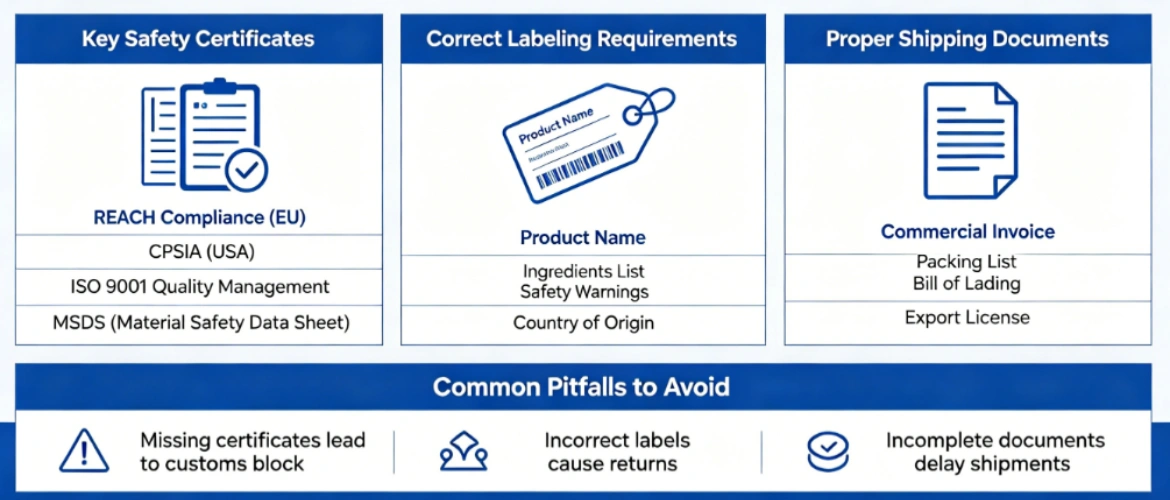
You have a great scented candle product. You want to sell it in other countries. But international rules can seem confusing. Different places ask for different papers and stamps. This can block your shipments or cause expensive returns.
To export scented candles successfully, you need the right safety certificates, correct labels, and proper shipping documents. These prove your product is safe and legal for the market you are entering.
This guide explains the key certificates and rules. It shows you how to prepare for smooth shipping and avoid common problems.
Which safety certifications are required for global markets?
You need to prove your candles are safe to burn. Different countries have different rules for this. A certificate that works in Europe might not be enough for America. Knowing what each market requires is the first step.
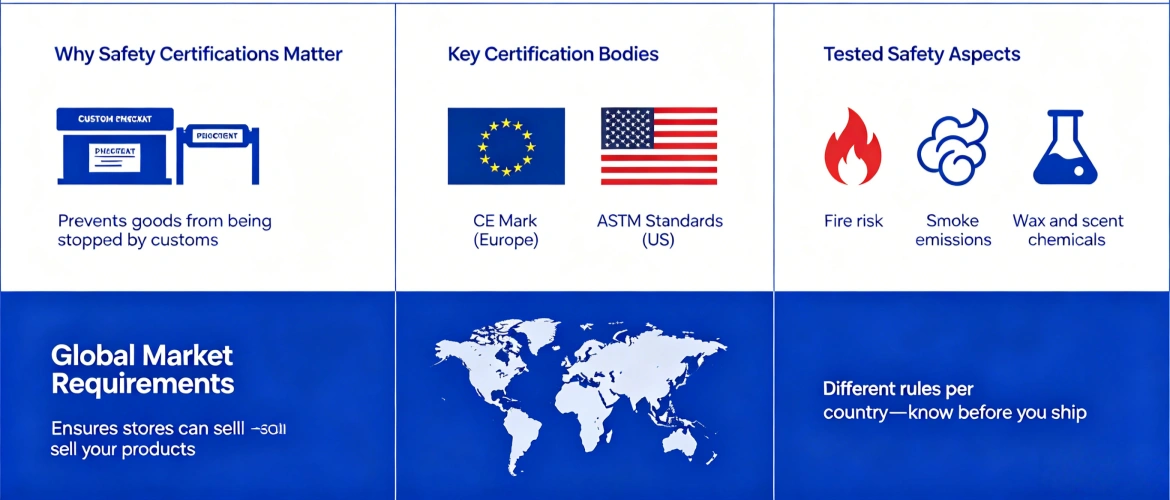
Safety certifications test things like fire risk, smoke, and the chemicals in your wax and scent. They are not just nice to have. For many markets, they are the law. Without them, customs can stop your goods, or stores can refuse to sell them.
Key safety certifications include the CE Mark for Europe, ASTM standards for the US, and various flammability and chemical tests required by major import countries. These ensure the candle meets basic safety performance standards.
Understanding the Major Safety Standards
Let’s break down the most important certificates by region. Think of these as a passport for your candles to enter a new country.
1. For the European Union (EU) & United Kingdom (UK)
The EU has strict product safety laws. For candles, the main focus is on the CE Mark.
- What it is: The CE Mark is a manufacturer’s declaration. It says, “This product meets all relevant EU health, safety, and environmental rules.”
- How to get it: You don’t apply to a government office. As the maker or seller, you must:
- Identify which EU safety directives apply to your candle (like the General Product Safety Directive).
- Have your candle tested, often by an independent lab, to prove it meets the standards. Key tests check for things like flame height, stability, and labeling.
- Create a technical file with all test reports and product details.
- Affix the CE Mark to your product and write a Declaration of Conformity.
- Why it’s critical: No CE Mark usually means you cannot legally sell your candle in the EU/UK. It’s the most basic requirement.
2. For the United States
The US does not have a single mandatory national certification like the CE Mark. Instead, safety is governed by standards and retailer requirements.
- ASTM F2417: This is the key voluntary standard for fire safety of candles. It tests burn time, flame height, and stability. While not a law, major US retailers (like Target, Walmart) and online platforms (like Amazon) often require products to be tested to this standard. In practice, it’s mandatory for doing business.
- California Proposition 65: This is a state law in California, but it affects national sales. It requires warnings if a product contains chemicals known to cause cancer or reproductive harm above a certain level. Some fragrance components can trigger this. You may need a lab test to confirm compliance.
- Consumer Product Safety Commission (CPSC): The CPSC enforces general product safety. They can recall products that are unsafe. Following ASTM standards helps show you meet CPSC expectations.
3. For Other Major Markets
- Canada: Looks for proof of compliance with the Canada Consumer Product Safety Act. Retailers often ask for test reports based on ASTM or similar standards.
- Australia/New Zealand: Requires compliance with the Australian Consumer Law. Specific standards like AS/NZS 15904 for candle safety are important. The ACCC (regulator) can demand test reports.
Quick-Reference Table: Key Safety Certs by Market
| Market | Key Safety Standard/Certification | Who Typically Requires It? |
|---|---|---|
| European Union | CE Mark (with supporting test reports) | Law. Required for market access. |
| United States | ASTM F2417 (Fire Safety Standard) | Major retailers & online marketplaces. |
| United States (California) | Prop 65 Compliance/Warning | Law for sales in California. |
| Canada | Evidence of compliance with Consumer Product Safety Act | Retailers and regulators. |
| Australia | AS/NZS 15904 (Candle Safety Standard) | Retailers and the ACCC. |
Remember: You don’t always send the certificate itself with each box. But you must have the test reports and documents ready. Customs or a buyer can ask for them at any time. Not having them can stop your shipment.
How do labeling rules vary by country?
The sticker on your candle jar is not just for your brand name. It is a legal document. It must give the buyer specific information in the right language and format. Getting the label wrong is a common reason for customs delays.
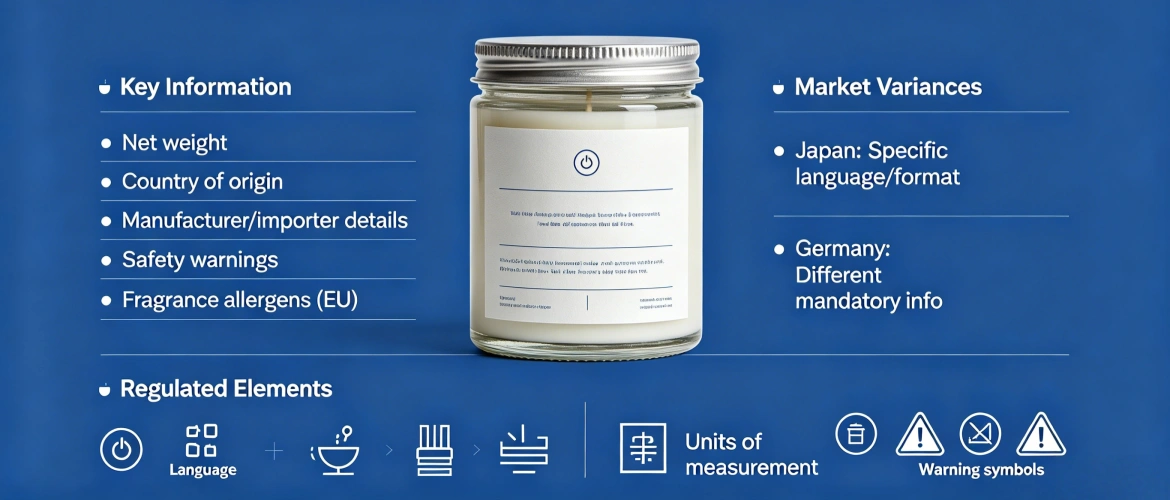
Labels tell customers what they are buying and how to use it safely. The rules change from country to country. What you must say in Japan is different from what you must say in Germany. You need to plan your labels for each market you enter.
Mandatory label information typically includes the product’s net weight, country of origin, manufacturer/importer details, safety warnings, and a list of key fragrance allergens (especially in the EU). The language, units of measurement, and specific warning symbols are regulated.
A Country-by-Country Labeling Guide
You can’t use one global label. Let’s look at the specific requirements in major markets.
1. European Union (EU) Label Rules
EU labels are among the most detailed. The information must be in the language of the destination country.
- What MUST be on the label:
- Product Identity: e.g., “Scented Candle.”
- Net Quantity: In grams (g) or milliliters (ml). Must be clear and prominent.
- Name and Address: of the EU-based importer or your company if you are based in the EU.
- Country of Origin: e.g., “Made in China.”
- List of 26 Allergens: If your fragrance oil contains any of 26 specific allergenic substances above 0.001% (for leave-on products) or 0.01% (for rinse-off), you must list them. Common candle allergens include Limonene, Linalool, Citronellol, etc. You need this information from your fragrance oil supplier.
- Batch/Lot Number: For traceability.
- Minimum Durability Date: An hourglass symbol with a date (e.g., “30M” for 30 months).
- Safety Warnings: Like “Keep away from children and pets,” “Never leave a burning candle unattended.” Often accompanied by specific warning pictograms (exclamation mark, flame symbol).
2. United States Label Rules
US rules are generally simpler but have key must-haves.
- What MUST be on the label:
- Product Identity & Net Weight: In both US Customary (oz) and Metric (g) units. Must be on the front panel.
- Name and Place of Business: of the manufacturer, packer, or distributor.
- Country of Origin: “Made in [Country].”
- Warning Statements: The US has specific, legally required warning language. For most candles, it is: “DANGER: Keep away from children and pets. Could cause fire, serious injury or death. Never leave burning candle unattended. Keep away from things that can catch fire. Place on a heat-resistant surface. Trim wick to 1/4 inch before lighting. Stop use when 1/2 inch of wax remains.”
- Fragrance Allergens: Unlike the EU, there is no mandatory list for home fragrance, but full ingredient disclosure is becoming a best practice, especially for “clean” brands.
3. Comparing Key Markets
| Label Element | European Union | United States | Canada | Australia |
|---|---|---|---|---|
| Net Weight Units | Metric (g/ml) only. | Dual (oz & g) required. | Metric (g) or Dual. | Metric (g/ml). |
| Allergen List | Mandatory (26 listed allergens). | Voluntary (but good practice). | Voluntary. | Voluntary. |
| Safety Warnings | Required, often with pictograms. | Specific, legally-mandated text required. | Required, similar to US. | Required. |
| Language | Language of destination country. | English. | English & French (for Canadian market). | English. |
| Importer Info | Mandatory (EU address). | Manufacturer/Distributor info. | Importer/Dealer info. | Supplier details. |
Actionable Tip: The safest approach is to create a master label template with all possible information. Then, for each country’s shipment, you can easily remove the non-required items and print in the correct language. Work with your packaging supplier to manage these variations efficiently.
What documents support smooth customs clearance?
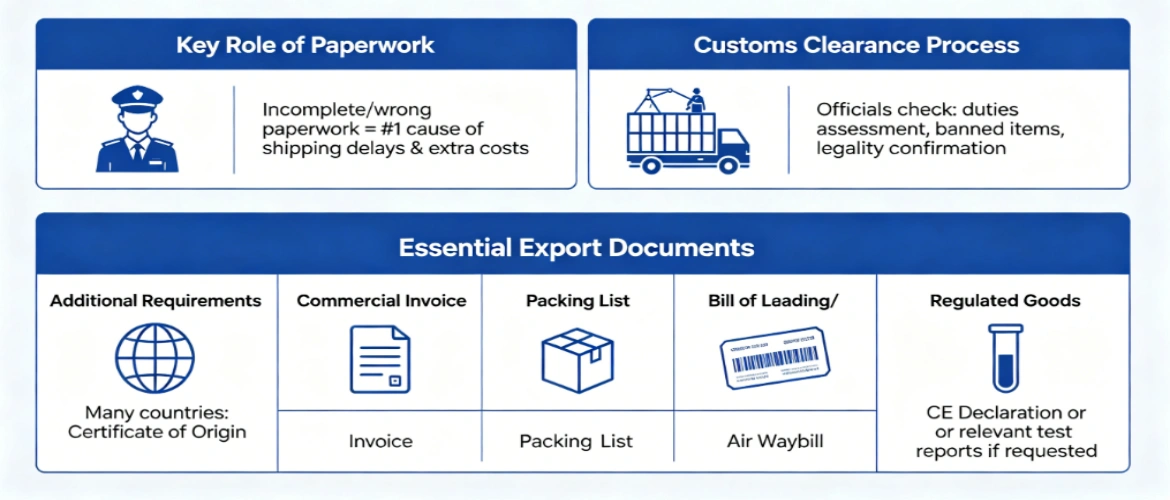
Your candles are made, certified, and labeled. Now you need to ship them. The paperwork for shipping is what tells the story of your goods to customs officers in two countries. Incomplete or wrong paperwork is the #1 cause of shipping delays and extra costs.
Customs clearance is the process where government officials check your goods can enter their country. They need documents to assess duties, check for banned items, and confirm everything is legal. Your freight forwarder or shipping agent will help, but you must provide the right information.
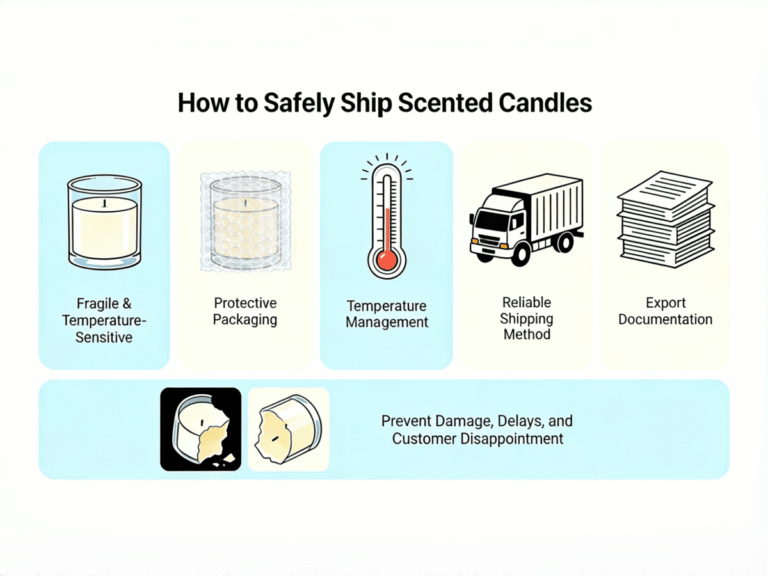
The essential export documents are the Commercial Invoice, Packing List, and Bill of Lading/Air Waybill. Many countries also require a Certificate of Origin. For regulated goods, the relevant test reports or certificates (like the CE Declaration) must be available if requested.
The Export Document Checklist
Think of this as a packet of papers that travels with your shipment (electronically or physically). Each document has a specific job.
1. The Core Three Documents (For Every Shipment)
These are the absolute basics. Without them, your shipment won’t move.
- Commercial Invoice: This is the “bill” for your goods.
- What it includes: Seller/Buyer details, detailed description of the candles (including HS Code), quantity, value per unit and total value, currency, incoterms (e.g., FOB, CIF), and country of origin.
- Why it’s critical: Customs uses this to calculate the import duties and taxes you or your buyer must pay. The value must be accurate.
- Packing List: This is the “map” of your shipment.
- What it includes: How many cartons, their dimensions and weight, what is inside each carton (e.g., “Carton 1: 24 pcs of Vanilla Soy Candle, 8 oz”). It links the commercial invoice to the physical boxes.
- Why it’s critical: Helps with logistics, loading, and customs inspection. Ensures the right quantity is shipped and received.
- Bill of Lading (Ocean) or Air Waybill (Air): This is the “contract & receipt” with the shipping company.
- What it is: A document issued by the carrier (shipping line or airline) that details the goods, destination, and terms of transport. The “consignee” (your buyer or their agent) needs the original to take possession of the goods.
- Why it’s critical: It proves ownership and is required to pick up the cargo at the destination port/airport.
2. Commonly Required Supporting Documents
Depending on the destination, you may also need:
- Certificate of Origin: A document certifying where the goods were made. Some countries require it for duty calculation or under trade agreements. It can be a simple self-declaration or one certified by a Chamber of Commerce.
- Material Safety Data Sheet (MSDS/SDS): While more common for raw chemicals, some cautious importers or carriers may request an SDS for the fragrance oils or wax, especially for air freight, to confirm they are not dangerous goods.
- Test Reports/Certificates: Copies of your ASTM, CE, or other safety test reports. Not always submitted upfront, but you must have them ready to provide if customs asks.
Document Flow at a Glance
| Document | Created By | Purpose | Who Needs It? |
|---|---|---|---|
| Commercial Invoice | You (Exporter) | Declare value for duties/taxes. | Customs (Export & Import), Buyer, Bank. |
| Packing List | You (Exporter) | List contents of each box. | Freight Forwarder, Customs, Buyer (for checking). |
| Bill of Lading | Shipping Line/Airline | Contract of carriage & title document. | Shipping Line, Customs, Buyer (to pick up goods). |
| Certificate of Origin | You/Chamber of Commerce | Prove manufacturing origin. | Customs (Import). |
Pro Tip: Be 100% accurate and consistent. The product description and value on the Commercial Invoice must match the Packing List and the actual goods. A mismatch is a red flag for customs and causes inspections and delays. Use a reliable freight forwarder; they are experts in this paperwork.
Why are compliance standards important for B2B exports?
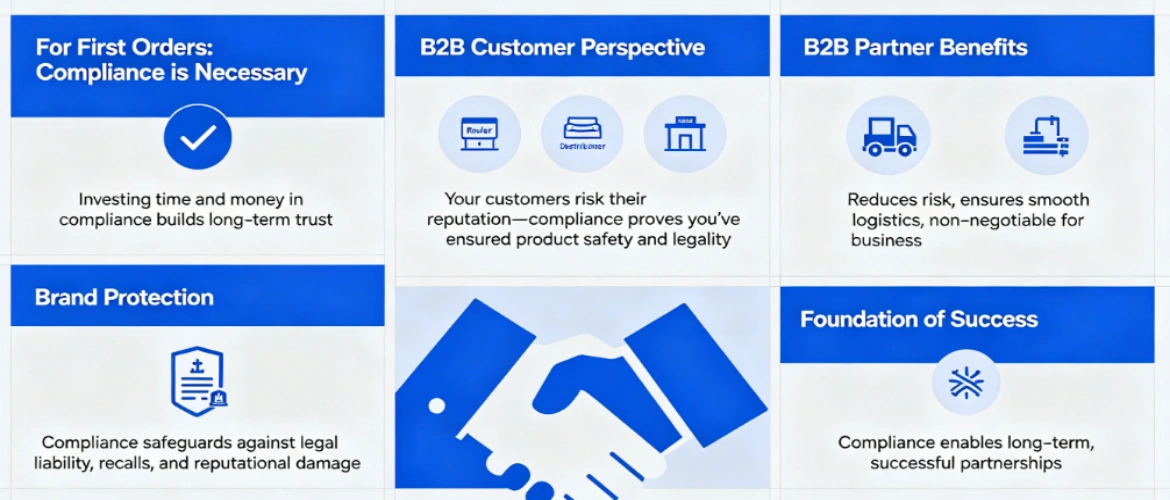
Following all these rules takes time and money. You might wonder if it’s really necessary, especially for a first order. The answer is yes. For B2B sales, compliance is not just about avoiding trouble; it’s about building a professional, trustworthy, and scalable business.
Your B2B customers (retailers, distributors, hotels) are risking their own reputation and business when they sell your product. They need to trust that you have done the work to ensure the candles are safe and legal. Compliance is the proof of that trust.
Compliance standards protect your brand from legal liability, recalls, and reputational damage. For B2B partners, they reduce risk, ensure smooth logistics, and are often a non-negotiable requirement for doing business. It is a foundation for long-term, successful partnerships.
The Business Case for Compliance
Let’s look beyond the paperwork to the real business benefits and risks.
1. It’s a Deal-Breaker for Professional Buyers
Large retailers and distributors have strict “vendor compliance” manuals. Before they even look at your product, they will ask for your certifications and test reports.
- The Buyer’s Perspective: They have been fined before for selling non-compliant products. They have faced lawsuits. They will not take that risk with a new supplier. Your ability to provide the correct documents is the first test of your professionalism.
- Real Ask: “Can you send me your ASTM F2417 test report and SDS for the fragrance oil?” If you cannot answer “yes” immediately, you lose the sale.
2. It Protects You from Costly Disasters
What happens if you skip compliance?
| Risk | Consequence | Cost |
|---|---|---|
| Customs Seizure | Your shipment is held at the border. | Loss of goods, shipping fees, storage demurrage charges, and wasted time. |
| Product Recall | A safety agency forces a recall of your candles from stores. | You pay for retrieving all products, destroying them, plus massive brand damage and potential lawsuits. |
| Retailer Chargebacks | The retailer fines you for non-compliant labeling or missing paperwork. | Direct financial penalties per shipment, often thousands of dollars. |
| Lawsuit | A faulty candle causes property damage or injury. | Without safety certifications, you have no defense. Legal fees and settlements can bankrupt a business. |
The cost of compliance (a few thousand dollars for testing) is tiny compared to the cost of one of these events.
3. It Enables Scalability and Peace of Mind
Once your product is fully certified for a market, it becomes an asset.
- Scale with Confidence: You can take larger orders, knowing the product can clear customs and be accepted by any retailer in that region.
- Streamline Operations: You have a clear, repeatable process for each shipment: use the certified formula, apply the correct label, and attach the standard documents.
- Build Your Brand Equity: “CE Certified,” “ASTM Tested” are marketing points. They tell consumers and buyers you care about quality and safety.
In the B2B world, compliance is not a barrier; it is the ticket to the game. It separates hobbyists from serious suppliers. Investing in it from the start is the smartest way to build an export business that lasts and grows.
Conclusion
Get the right safety tests, make accurate labels, prepare complete shipping papers, and see compliance as a key business asset. This is the reliable way to export candles globally.