Scented Candle Supplier



What Is MOQ in Scented Candle Wholesale?
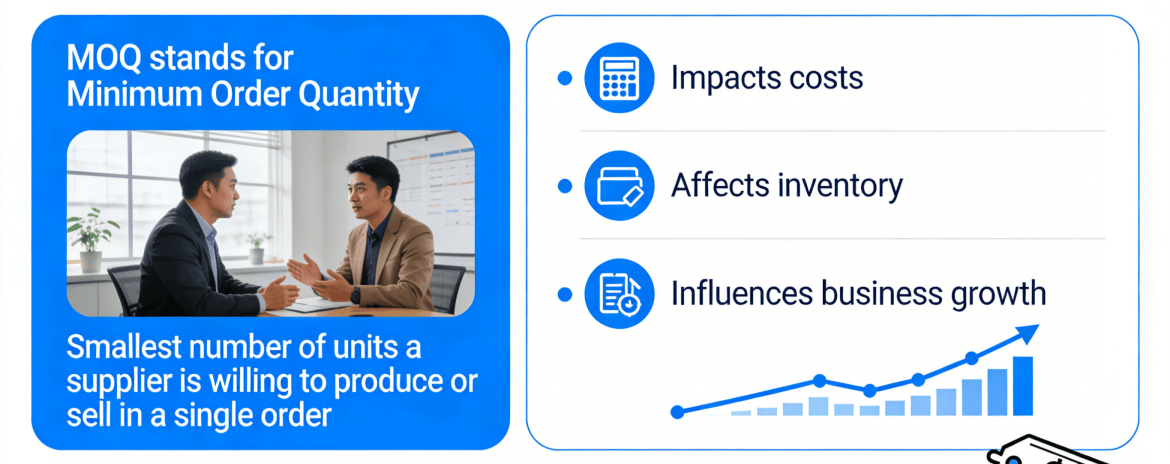
If you’re purchasing scented candles to resell, you’ve probably noticed the term “MOQ” on supplier websites and price lists. As a fundamental aspect of wholesale buying, it can initially seem confusing. However, understanding MOQ in Scented Candle Wholesale is crucial because it directly impacts your costs, inventory management, and your ability to grow your business profitably.
MOQ stands for Minimum Order Quantity. It is the smallest number of units a supplier is willing to produce or sell in a single order. Meeting the MOQ is a requirement to purchase at wholesale prices.
Let’s break down what MOQ means for you, how it affects your pricing, and the strategies you can use to work with it effectively.
1. What Does MOQ Mean for Candle Buyers?
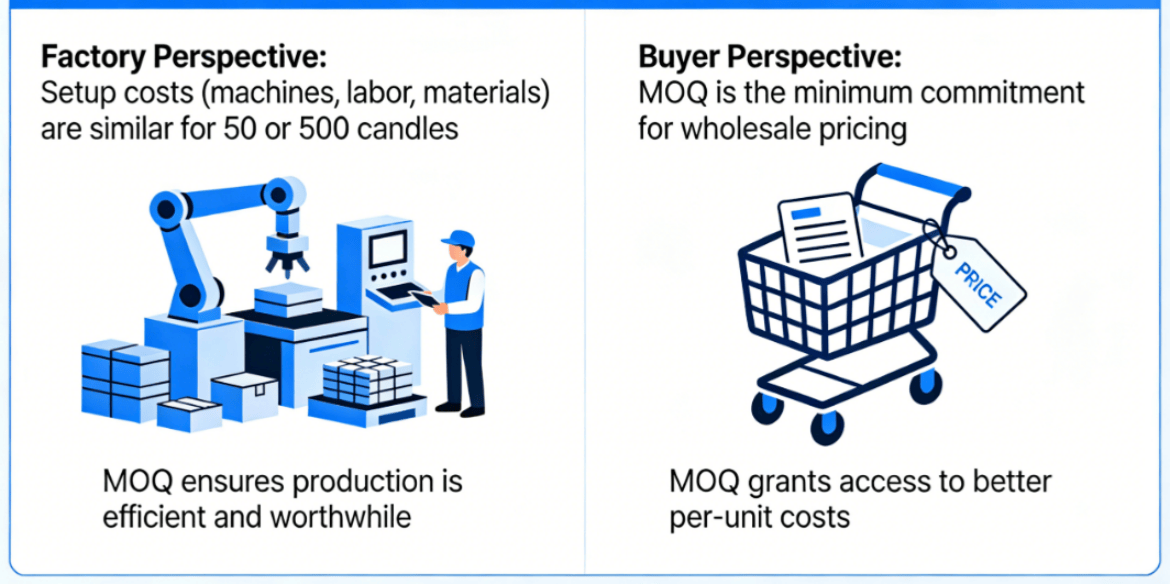
At its core, MOQ is a rule that protects both you and the supplier. It sets a clear starting point for a wholesale transaction. For a factory, producing candles involves setup costs for machines, labor, and materials. These costs are similar whether they make 50 candles or 500. The MOQ ensures that an order is large enough to make production efficient and worthwhile for them.
For you, the buyer, MOQ determines the minimum commitment you must make to access wholesale pricing. It’s the gatekeeper to better per-unit costs.
Common Types of MOQ
Suppliers can set MOQs in different ways. It’s important to know which type you’re dealing with.
| MOQ Type | What It Means | Example |
|---|---|---|
| Per-Order MOQ | Minimum total units across all items. | “You must order at least 200 candles total.” |
| Per-Scent MOQ | Minimum units for each individual fragrance. | “You must order at least 24 of the ‘Vanilla Bean’ scent.” |
| Per-Design MOQ | Minimum for custom labels or jars. | “A custom label design requires a 500-unit order.” |
| Order Value MOQ | Minimum total dollar amount spent. | “Your total cart must be at least $500.” |
Why MOQ Matters for Your Business
- Budgeting: It tells you the minimum cash you need upfront.
- Planning: It helps you forecast how much inventory you’ll have.
- Supplier Quality: Professional suppliers have clear, consistent MOQ policies. Vague or shifting MOQs can be a red flag.
Think of MOQ as the entry ticket. You need it to get in the door and start building a relationship with a manufacturer that can support your growth.
2. How Does MOQ Affect Pricing and Profit Margins?
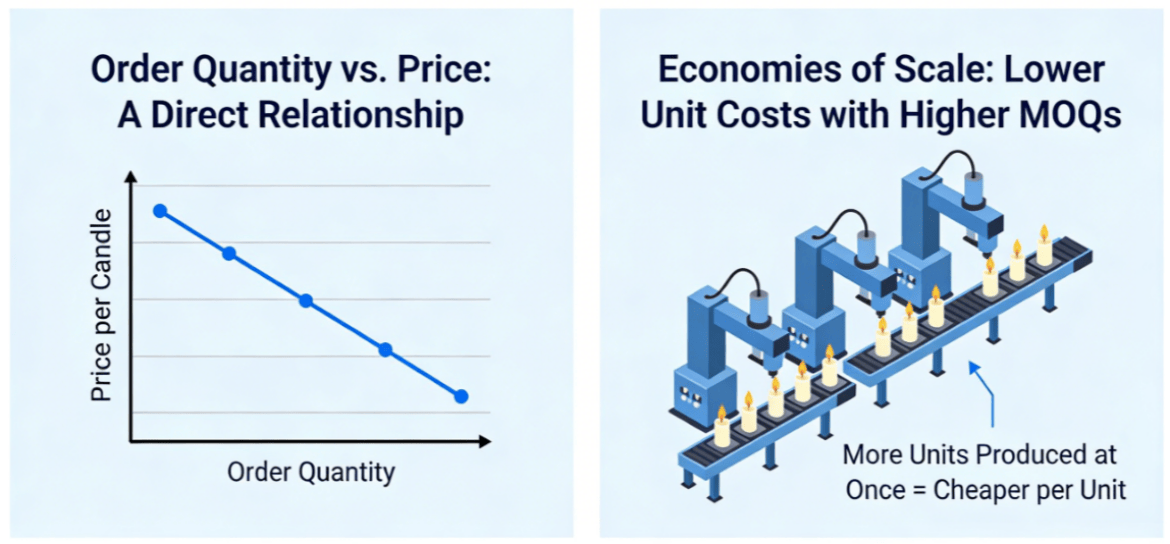
This is where MOQ gets really important for your bottom line. There’s a direct and powerful relationship between order quantity and price.
Higher MOQs almost always lead to lower prices per candle. This is due to “economies of scale”—it becomes cheaper for the factory to produce each unit when they make more at once.
The Cost Breakdown: Why More is Cheaper
Imagine a factory needs to spend $200 to set up a production line (cleaning machines, preparing scents, etc.). That cost gets divided by the number of candles they make.
- For 50 candles: Setup cost is 200/50=∗∗4 per candle** just for setup.
- For 500 candles: Setup cost is 200/500=∗∗0.40 per candle** for setup.
When you order more, you absorb a much smaller piece of those fixed costs, leading to a lower final price.
Real Impact on Your Profit
Let’s look at how this plays out with example numbers:
| Order Quantity | Your Cost Per Candle | Your Potential Retail Price | Your Profit Per Candle |
|---|---|---|---|
| 100 pieces (Low MOQ) | $4.50 | $12.00 | $7.50 |
| 500 pieces (Medium MOQ) | $3.20 | $12.00 | $8.80 |
| 2,000 pieces (High MOQ) | $2.40 | $12.00 | $9.60 |
The takeaway: While a larger MOQ requires more cash upfront, it significantly boosts your profit margin on each candle you sell. The key is to balance the desire for high margins with the reality of your budget and sales forecast.
3. What MOQ Options Are Right for Small or Large Orders?
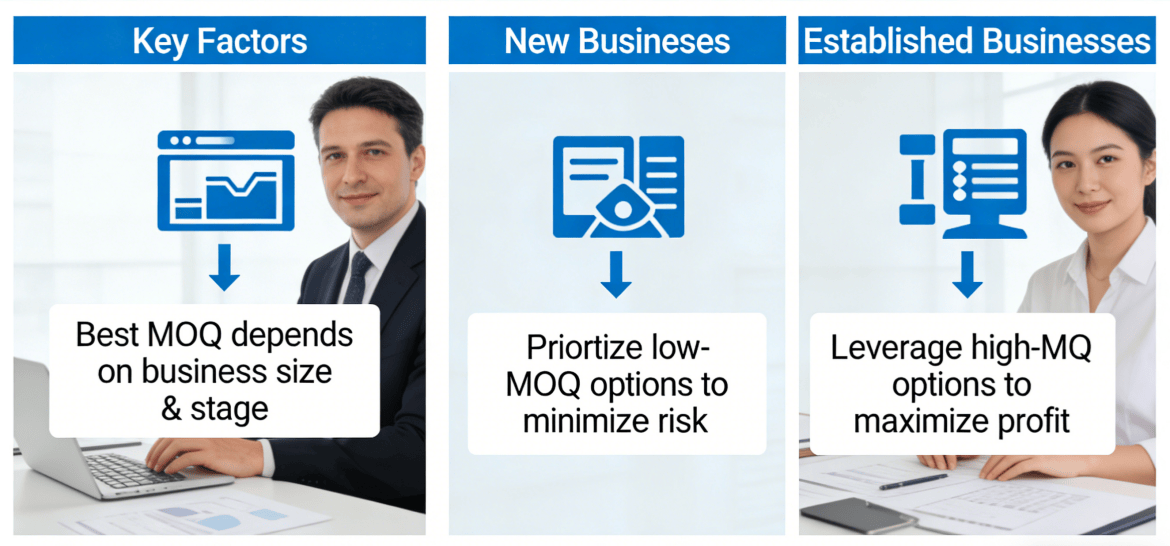
There isn’t one “right” MOQ for everyone. The best choice depends entirely on your business’s current size and stage. The good news is that professional suppliers often offer different pathways.
New businesses should prioritize low-MOQ options to minimize risk. Established businesses should leverage high-MOQ options to maximize profit.
Finding Your Fit
Use this guide to match an MOQ strategy to your situation:
| Your Business Stage | Ideal MOQ Strategy | Why It Works |
|---|---|---|
| Just Starting / Testing | Low MOQ (50-200 units) | Lets you validate scents and demand with minimal cash and inventory risk. |
| Growing Steadily | Medium/Tiered MOQ (200-1,000 units) | Offers a good balance of better pricing without over-extending your storage or budget. |
| Established / Scaling | High MOQ (1,000+ units) | Unlocks the lowest costs, highest profits, and often priority service from suppliers. |
Flexible Strategies for Any Size
Don’t feel locked into one box. Many suppliers offer smart solutions:
- Mixed Orders: Combine several fragrances to meet a total order MOQ (e.g., 50 of Scent A + 50 of Scent B to hit a 100-unit MOQ).
- Tiered Pricing: Commit to a certain annual volume in exchange for lower per-order MOQs.
- Blanket Orders: Agree to a large total quantity for the year, but have it produced and shipped in smaller batches.
The goal is to find a supplier who works with you, not just for a single transaction, but as a partner in your growth.
4. How Can You Negotiate Better MOQ Terms?
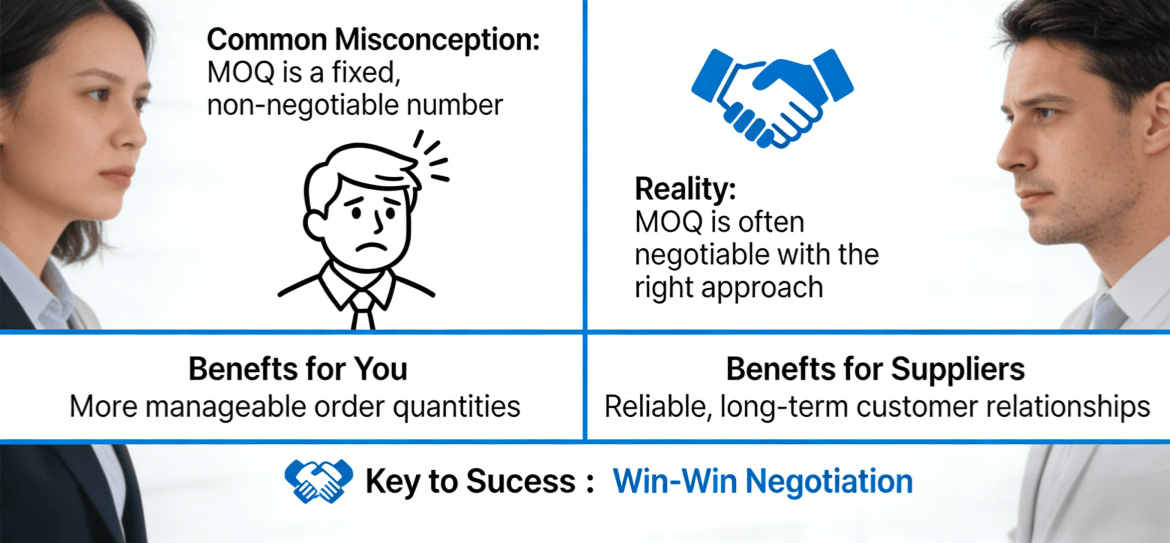
Many buyers think MOQ is a fixed, non-negotiable number. In many cases, it’s not! With the right approach, you can often secure more favorable terms, especially if you’re building a relationship with a supplier.
Successful MOQ negotiation is about creating a win-win: you get more manageable terms, and the supplier gains a reliable, long-term customer.
Effective Negotiation Tactics
Try these professional strategies:
- Show Long-Term Potential: Explain your business plan. A supplier is much more likely to offer a lower trial MOQ if they believe you’ll become a repeat, growing customer.
- Be Flexible on Design: Ask if using a standard jar or an existing fragrance from their library would qualify for a lower MOQ than a fully custom item.
- Combine SKUs: Propose meeting the total order MOQ by mixing and matching several different candle scents or designs.
- Ask About Off-Season Orders: Production can be slower at certain times of year. Suppliers may be more flexible with MOQs to keep their lines running.
- Consider a Slight Price Increase: Sometimes, you can propose paying a bit more per candle in exchange for a significantly lower MOQ. This can be a great way to test a product with less risk.
What to Avoid
- Making Demands: Negotiation is a conversation, not an ultimatum.
- Ignoring Their Costs: Show that you understand they have to cover their expenses. This builds respect.
- Burning Bridges: Even if you can’t agree this time, stay professional. The market is smaller than you think.
Remember, the most powerful tool in negotiation is being a good customer—paying on time, communicating clearly, and being respectful of the supplier’s process.
Conclusion
MOQ is more than just a number on a price list—it’s a strategic lever in your wholesale candle business. It shapes your initial costs, the profit on every sale, and your capacity to scale.
When navigating MOQ in Scented Candle Wholesale, begin by choosing a quantity that aligns with your current capacity and risk comfort. Starting small is a practical and valid approach. As your sales grow, you can strategically increase order sizes to lower costs and improve margins.
Lastly, keep in mind that MOQ is often a starting point for conversation. By engaging suppliers as potential long-term partners, you can often negotiate terms that support your business growth while also contributing to theirs.