Scented Candle Supplier



Scented Candles vs Diffusers: Which Is Better for Homes?
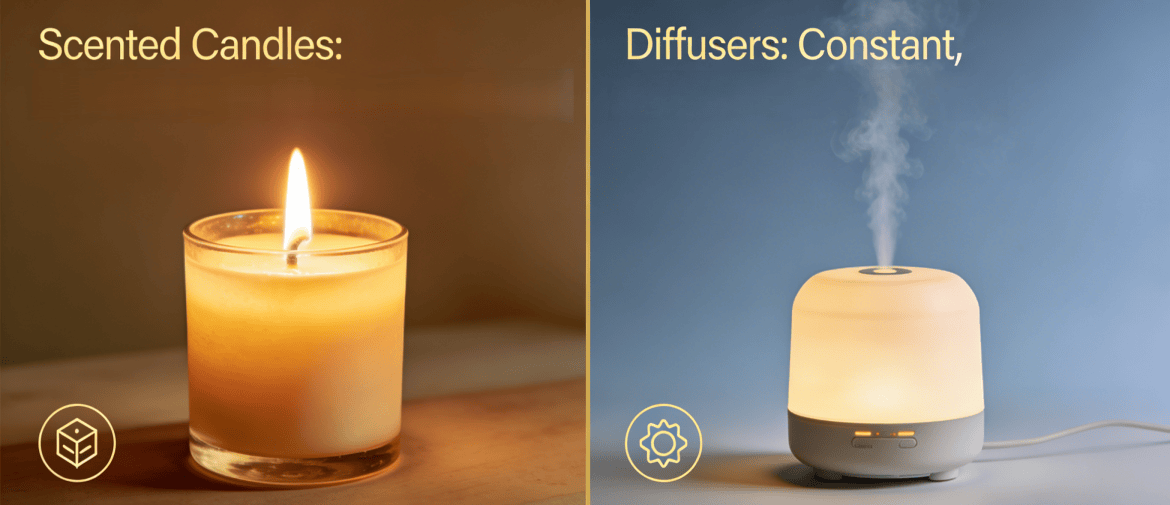
Choosing home fragrance confuses many buyers. They struggle between scented candles and diffusers. I help solve this mismatch. Each option serves different needs in modern homes. The right choice transforms daily living.
Scented candles offer warmth, light, and immediate scent. Diffusers provide constant, hands-free fragrance. The better choice depends on your priority: ambiance and ritual, or steady, low-maintenance scent coverage.
Let me explain the key differences to help you make the right decision for your space.
How do candles and diffusers differ in scent delivery?
People expect all home fragrance to work the same way. This leads to disappointment. Candles and diffusers release scent through completely different methods. I see this confusion daily in my work with clients.
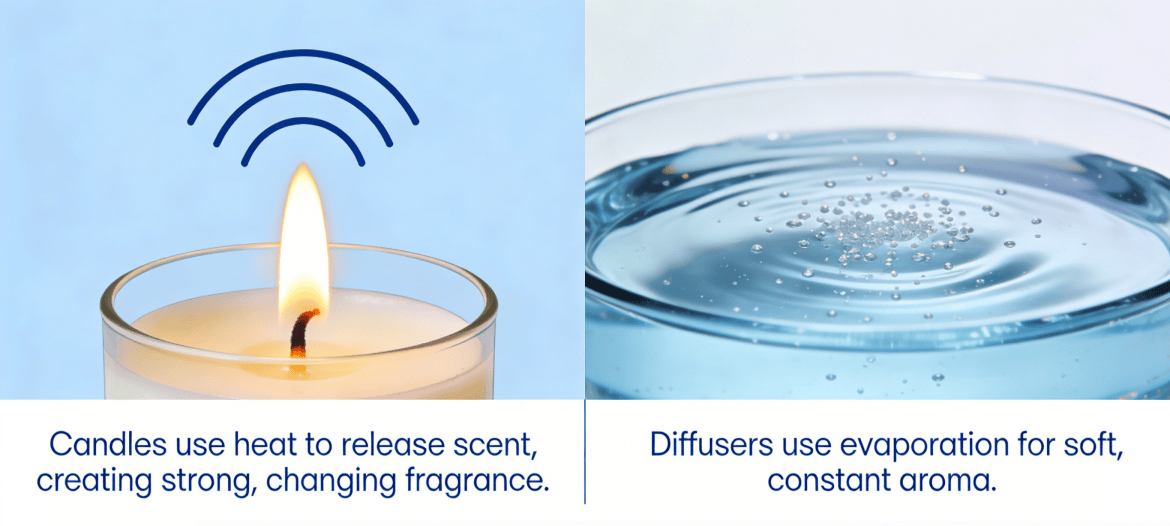
Candles use heat to release scent, creating strong, changing fragrance. Diffusers use evaporation for soft, constant aroma. This fundamental difference shapes the entire user experience.
Understanding the mechanics behind the scent
The delivery method determines everything about performance. Let’s examine how each system actually works.
The heat-driven system of scented candles
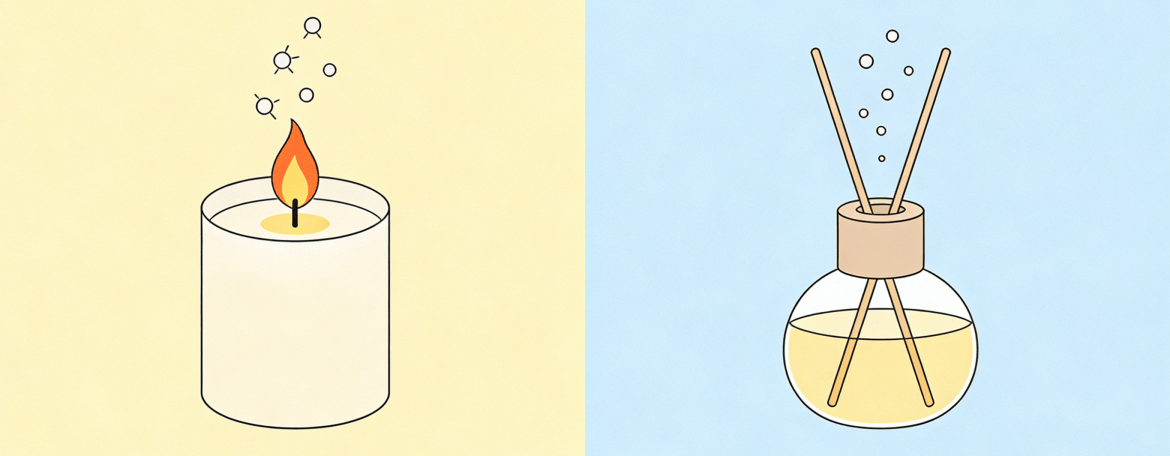
A candle is essentially a small heating device. The flame melts wax, which then heats the fragrance oil mixed within. This heat causes the oil to vaporize and release scent into the air.
Key characteristics of candle scent delivery:
- Activation Method: Requires a live flame (or electric heating element)
- Scent Dynamics: Creates a powerful “hot throw” that projects scent molecules forcefully
- Pattern: Scent comes in waves – builds, peaks, and fluctuates
- User Engagement: Demands active participation through lighting and monitoring
The evaporation-based system of diffusers
Diffusers operate without heat. They rely on natural evaporation or mechanical misting to disperse fragrance.
Two main types:
- Reed Diffusers: Rattan sticks soak up fragrance oil from a bottle. The oil travels up the reeds and evaporates into the air naturally.
- Electric/Aroma Diffusers: Ultrasonic plates vibrate to create a fine mist from water and oil mixtures.
Key characteristics of diffuser scent delivery:
- Activation Method: Passive (reeds) or electric (ultrasonic)
- Scent Dynamics: Creates a gentle, consistent “cold throw” that forms a scent halo
- Pattern: Steady, unchanging fragrance level
- User Engagement: Mostly “set and forget” after initial setup
Comparing delivery systems side by side
| Aspect | Scented Candles | Diffusers |
|---|---|---|
| Core Mechanism | Heat vaporization of fragrance oil in melted wax | Passive evaporation or active misting |
| Scent Strength | Strong, projective, can fill medium-large rooms | Soft, ambient, localized to immediate area |
| Activation Required | Manual lighting and extinguishing | Automatic after setup (reeds) or with switch (electric) |
| Duration per Activation | 20-80 hours of active burn time | 1-3 months of continuous operation from one fill |
| Consistency | Fluctuates with burn time and wax pool | Remarkably steady day-to-day |
The essential insight: Think of Scented Candles vs Diffusers as comparing a fireplace to central heating. The candle (fireplace) creates intense, focused ambiance for special occasions. The diffuser (central heating) maintains a consistent, comfortable background environment. Each serves a valid purpose, but for different situations.
Practical application: In my testing for hotel clients, I placed identical lavender scents in both formats in similar rooms. The candle created a noticeable “scent event” that guests mentioned immediately. The diffuser provided a subtle, constant presence that guests appreciated as a background element. Neither was “better” – they created different experiences from the same fragrance.
Which option fits different rooms and lifestyles?
A product might be excellent but wrong for its intended space. I’ve seen beautiful candles gathering dust in busy kitchens. I’ve watched diffusers fail to impact large living areas. The right choice matches the product to the room’s function and the user’s daily patterns.
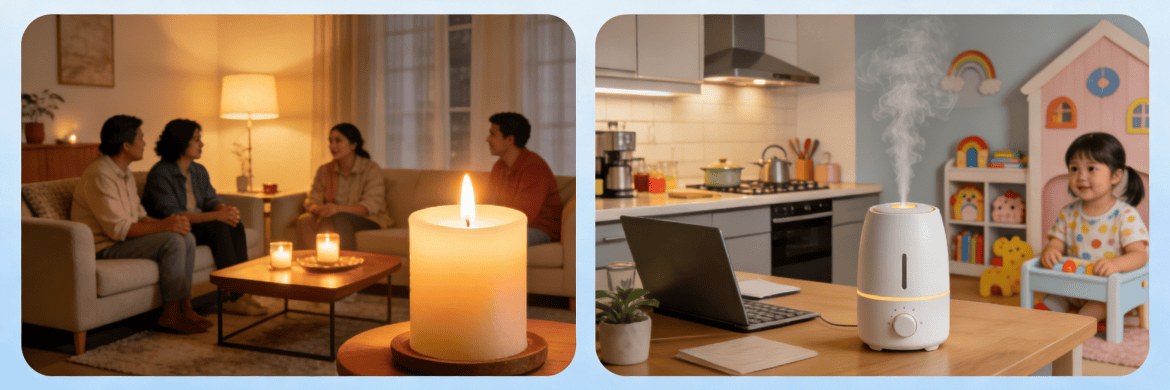
Candles suit spaces for relaxation, socializing, and intentional ambiance. Diffusers work best in functional, high-traffic, or safety-sensitive areas. Your lifestyle patterns determine which format delivers real value.
Matching format to room function
Every room in a home serves different purposes. The fragrance product should support – not fight against – that room’s primary function.
Where scented candles deliver maximum value
Candles excel in spaces where users are present, engaged, and seeking to enhance a specific mood or moment.
- Living & Dining Areas: Social spaces benefit from candles’ warm glow and strong scent throw. They create inviting atmospheres for gatherings, enhance dining experiences, and make ordinary evenings feel special. The ritual of lighting signals transition into relaxation or celebration mode.
- Bedrooms (for winding down): A curated candle scent (like lavender or chamomile) paired with soft light creates powerful sleep signals. The key is using it as a pre-bed ritual, extinguishing before actual sleep.
- Bathrooms (for baths only): The classic bath companion. The flame is safe from water splashes (unlike electric devices nearby), and the scent enhances luxurious soaking experiences.
The ideal candle user: Values rituals, is often home during evenings/weekends, has no young children or free-roaming pets, and prioritizes ambiance over convenience.
Where diffusers are the smarter solution
Diffusers serve as fragrance workhorses for spaces needing constant freshness or where flames pose practical problems.
- Bathrooms (daily use): The premier location for reed diffusers. They provide 24/7 odor control and pleasant scent with zero daily effort and no flame risk near flammable materials.
- Entries & Hallways: Pass-through spaces don’t warrant lighting candles. Diffusers offer constant welcoming fragrance that greets everyone entering.
- Home Offices: Electric diffusers with focus-enhancing scents (citrus, peppermint) can run throughout workdays without requiring attention or posing fire risks near papers/electronics.
- Small Apartments: A single well-placed diffuser can maintain baseline fragrance throughout compact living spaces more efficiently than multiple candles.
The ideal diffuser user: Lives a busy lifestyle, values convenience and safety, has children/pets, or is frequently away from home but wants returning to a pleasantly scented space.
Room-by-room application guide
| Room | Primary Functions | Recommended Format | Rationale |
|---|---|---|---|
| Living Room | Relaxation, Socializing, Entertainment | Scented Candle | Creates focused atmosphere; light complements activities |
| Bedroom | Sleep, Intimacy, Relaxation | Candle (ritual) or Diffuser (all-night) | Candle for pre-sleep routine; diffuser for constant calm scent |
| Bathroom | Function, Hygiene, Short Relaxation | Diffuser (daily) & Candle (bath luxury) | Diffuser for 24/7 freshness; candle for bath-time enhancement |
| Kitchen | Cooking, Food Prep, Odor Control | Diffuser (fresh/citrus scents) | Constant odor neutralization; safer than open flame near cooking |
| Home Office | Focus, Productivity, Work | Electric Diffuser (energizing oils) | Steady, subtle scent aids concentration; no open flame distraction |
| Entryway | First Impressions, Transition Space | Reed Diffuser | Provides constant welcoming scent with zero maintenance |
A real client example: A professional couple in a compact apartment initially used a strong living room candle nightly. They found it overpowering in the small space and felt obligated to “use it up” once lit. We reconfigured their approach: a reed diffuser in the bathroom, a fresh linen diffuser in the kitchen area, and a small, short-burn candle reserved for weekend dinners. The diffusers handled daily background scent, while the candle became a special treat. The products finally matched their actual living patterns.
Lifestyle consideration table:
| Lifestyle Factor | Better Fit | Primary Reason |
|---|---|---|
| Busy, On-the-Go Schedule | Diffuser | Requires minimal attention/planning |
| Mindful, Ritual-Oriented | Candle | Provides intentional sensory pauses |
| Household with Children/Pets | Diffuser | Eliminates flame safety concerns |
| Frequent Traveler | Diffuser | Maintains pleasant scent while away |
| Evening Homebody | Candle | Enhances wind-down routines |
| Entertainment Host | Candle | Creates immediate atmospheric impact |
Your home isn’t a showroom – it’s a living system. Choose tools that fit the jobs each space needs to perform and that align with how you actually live day-to-day. The Scented Candles vs Diffusers decision is ultimately about matching tools to tasks.
What do buyers consider for long-term fragrance use?
Initial fragrance appeal grabs attention, but long-term satisfaction determines repurchase. Buyers often think short-term about scent preference alone. I help them evaluate the complete lifespan of a fragrance product. Smart consideration prevents future disappointment.
For long-term use, buyers evaluate cost-per-hour, maintenance commitment, household safety, and scent consistency. Candles offer finite luxury experiences. Diffusers provide economical continuous scent with different upkeep requirements.
Calculating true long-term value
The price tag shows only initial cost. Real value emerges over the product’s complete home lifespan. Let’s analyze long-term considerations systematically.
The economics of ongoing fragrance
How much does each hour of fragrance actually cost? The calculations differ dramatically.
- Scented Candle Economics:
- Initial Investment: $30-$50 for a high-quality candle with 50+ hour burn time
- Cost Per Fragrant Hour: $0.60-$1.00 per hour of active use
- The Experience Premium: Price includes vessel aesthetic, ritual value, and decorative element
- Realistic Timeline: Burning 2 hours nightly = 25 days of use
- Diffuser Economics:
- Initial Investment: $35-$60 for vessel and first oil fill (lasting 3 months)
- Cost Per Month: $12-$20 monthly for 24/7 continuous fragrance ($0.02/hour)
- The Convenience Value: Price covers “always on” functionality with minimal effort
- Ongoing Costs: $20-$30 for refill oils every 3-4 months
Economic verdict: For pure continuous scent coverage, diffusers are significantly more economical annually. Candles represent intermittent luxury experiences, like dining out versus daily home cooking.
Maintenance commitments over months
How much ongoing effort will this product demand?
- Candle Upkeep: Includes wick trimming before burns, monitoring burn time, proper extinguishing, and eventual jar cleaning/disposal. Effort is concentrated around usage moments.
- Diffuser Upkeep: Reed diffusers need stick flipping weekly/bi-weekly. Electric diffusers require water/oil refilling every few days. Oil bottles eventually empty, requiring refill purchases. Effort is sporadic but perpetual.
Household safety considerations
Long-term safety is non-negotiable, especially for families.
- Candle Safety Reality: Open flame presents perpetual risk requiring constant supervision. Concerns multiply with children, pets, or forgetful habits. This risk repeats with every single use.
- Diffuser Safety Profile: Minimal risk – no flame, no hot surfaces. Primary concerns are oil spillage (damaging surfaces) and proper placement of electric units away from water.
Scent longevity and perceptual adaptation
Will the fragrance remain effective over time?
- Candle Scent Dynamics: Intermittent use prevents olfactory adaptation. Each lighting can feel fresh. However, scent in the jar can degrade over months if stored improperly.
- Diffuser “Scent Fatigue”: Constant exposure often causes “nose blindness” – users stop noticing the scent within weeks while guests still detect it. This can prompt unnecessary reed flipping or premature refill purchases.
Long-term consideration comparison
| Consideration | Scented Candle Implications | Diffuser Implications |
|---|---|---|
| Cost Over 6 Months | Higher per-fragrant-hour; pays for experience | Lower per-hour; pays for convenience |
| Maintenance Pattern | Ritual-centric (lighting/trimming); jar cleanup | Sporadic (reed flipping/refilling); less daily thought |
| Safety Timeline | Repeated, predictable flame risk requiring vigilance | Minimal ongoing risk beyond initial placement |
| Scent Longevity | Potent but finite (20-80 active hours); may degrade in jar | Continuous (1-3 months); user adaptation likely |
| Ideal Household | Adults, mindful users, pet-free homes, frequent entertainers | Busy households, families, renters, frequent travelers |
The critical question for buyers: Beyond “Do I like this scent?” ask “Will I actually light this 50 times?” and “Will I maintain reed flipping routines?” Your authentic habits – not aspirational ones – determine which product delivers lasting satisfaction. This practical reality check is essential in the Scented Candles vs Diffusers evaluation.
How should brands approach the candles vs diffusers decision?
Brands should decide based on core product story, target customer experience desires, and production capabilities. Wellness brands might begin with diffusers. Decor brands typically start with candles. Most eventually offer both to serve complete fragrance needs.
A strategic framework for product development
Adding a fragrance format is a significant business decision. It must align with brand DNA and serve identifiable market needs.
Step 1: Align with core brand narrative
Your product format physically expresses your brand promise. What do you fundamentally provide?
- Experience & Ambiance Brands: If you sell cozy evenings, self-care rituals, and “moment creation,” your natural home is scented candles. The candle embodies the experience – flickering light, personal ritual, transformative scent event. Marketing emphasizes mood, setting, sensory indulgence.
- Wellness & Lifestyle Brands: If you promote daily well-being, clean living, and holistic health, your natural home might be diffusers, especially for essential oils. Diffusers support 24/7 therapeutic atmospheres and are perceived as aromatherapy tools.
- Design & Decor Brands: If you focus primarily on beautiful home objects, you have options. Beautiful vessels work for both formats, though candle jars often have greater decorative presence when unlit.
Guiding question: Are you in the “mood business” (candles) or the “climate business” (diffusers)? Your answer directs the Scented Candles vs Diffusers strategic choice.
Step 2: Understand target customer journeys
Who buys from you, and what do they want to do with your product?
- The Gift Buyer: Candles dominate gifting – they’re complete, beautiful, indulgent packages. Diffusers can be gifts but are often viewed as more practical purchases.
- B2B Buyers (Hotels/Spas/Offices): Needs vary specifically. Hotels use candles for turndown service/suites (luxury) and diffusers in lobbies/bathrooms (constant safe scent). Spas use diffusers in treatment rooms for continuous therapeutic atmosphere. Corporate offices prefer flameless diffusers for safety and air quality.
- Subscription/Loyalty Customers: Diffusers can drive recurring revenue through refill sales. Candle purchases may be less predictable – tied to seasons, collections, or gifting cycles.
Step 3: Evaluate operational capabilities
Producing candles versus diffuser oils involves different processes, skills, and infrastructure.
| Operational Factor | Scented Candle Production | Diffuser Production |
|---|---|---|
| Core Process | Wax formulation, wick selection, fragrance blending, vessel filling | Fragrance oil formulation, carrier blending, bottling, reed selection |
| Required Expertise | Wax chemistry, burn performance testing, thermal dynamics | Oil dilution, evaporation rates, solvent properties |
| Equipment Needs | Melting/pouring equipment, curing spaces, wick-setting tools | Mixing tanks, bottling lines, quality control for evaporation |
| Inventory Profile | Heavy/bulky finished goods; scent may degrade in wax over years | Compact liquid storage; oils stable for years in sealed containers |
| Customization Potential | High – custom vessels, colored wax, complex scent layering | Moderate – custom bottles/labels; scent customization in oil blend |
Step 4: The portfolio strategy
Most established home fragrance brands ultimately offer both, but with strategic positioning.
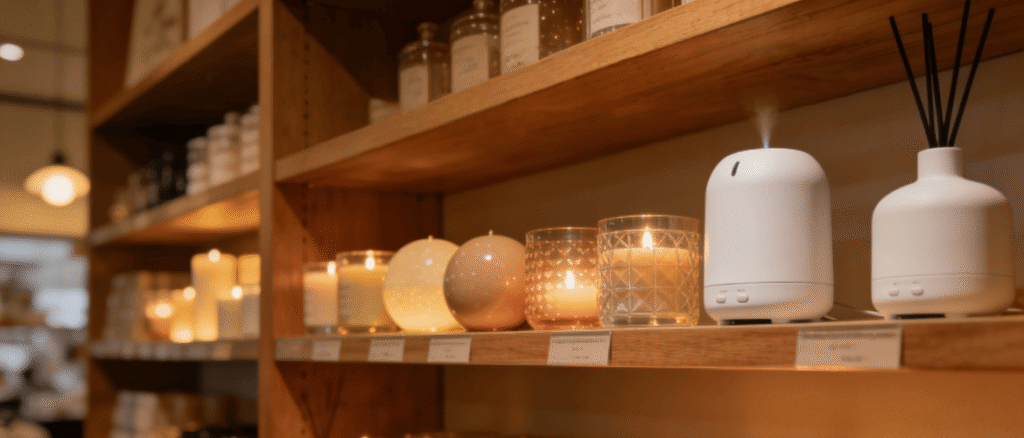
- The “Hero & Hub” Model: Candle as hero product (iconic, high-margin, brand-defining). Diffuser as hub product (practical, everyday, entry-point that keeps brand in daily use). Example: Customer buys luxury candle, then matching diffuser for bathroom.
- The “Scent Story” Model: Launch fragrance in candle format first. Build following and narrative. After 6-12 months, introduce same scent in diffuser format. This satisfies existing fans and reaches diffuser-preferring customers.
Strategic recommendation: Begin with the format most authentic to your core brand story and existing capabilities. But plan for the complementary format. Today’s fragrance consumers often desire scent wardrobes for different rooms and occasions. Understanding the fundamental Scented Candles vs Diffusers distinctions lets you strategically build a product ecosystem meeting all customer needs.
Conclusion
Scented candles and diffusers serve different home fragrance needs. Candles provide ritual, warmth, and transformative scent moments. Diffusers deliver safety, consistency, and effortless continuous fragrance. The optimal choice depends on your specific rooms, lifestyle patterns, and what you value most in your home’s atmosphere.