Scented Candle Supplier



Behind the Scenes: How Scented Candles Are Made?
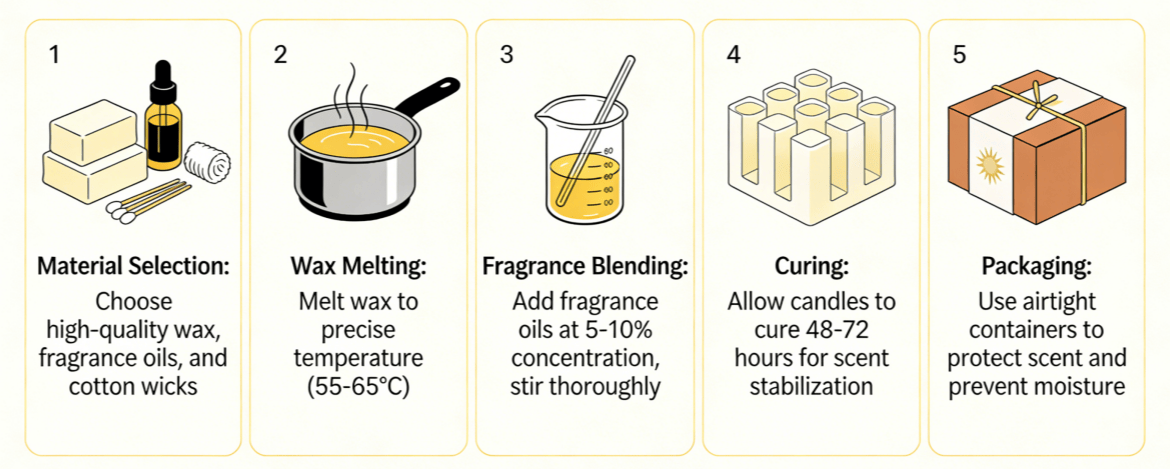
The journey from simple ingredients to a beautifully fragrant candle involves precise science and careful craftsmanship. Each stage, from material selection to final packaging, directly impacts the candle’s performance, safety, and sensory appeal.
Creating a scented candle involves material selection, precise wax melting, fragrance blending, curing, and protective packaging. Each step requires controlled conditions and quality checks to ensure optimal burn, safety, and scent delivery.
Understanding this process reveals the craftsmanship behind every candle and helps explain differences in quality and performance. Let’s explore the detailed, step-by-step journey.
What materials are selected for quality candles?
The journey to a superior candle begins by selecting premium, compatible materials. We choose each component for its specific function and key performance characteristics.
Fundamentally, the curing process allows fragrance molecules to fully bind with the wax’s crystalline structure, which in turn creates a stable matrix. Importantly, this matrix then ensures the scent releases consistently and powerfully when the candle is burned. Ultimately, as a result of this carefully orchestrated molecular bonding, curing effectively enhances both the cold throw (the unlit scent) and the hot throw (the scent while burning)—two key factors that define a candle’s sensory appeal.
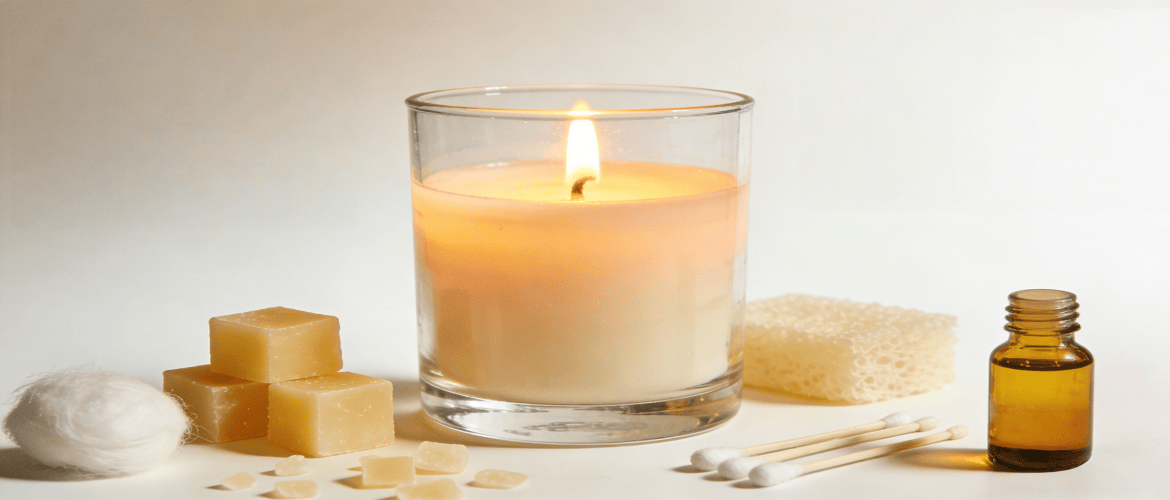
Wax: The Foundation
The wax base influences burn time, scent retention, and environmental impact. Artisans select from several high-performance options.
| Wax Type | Primary Characteristics | Best For |
|---|---|---|
| Soy Wax | Natural, biodegradable, clean burn, excellent scent throw | Clean-burning, strongly scented candles |
| Coconut Wax | Luxurious texture, superior scent retention, very clean burn | Premium, high-end candle lines |
| Paraffin Blends | Strong hot throw, bright color compatibility, economical | Mass-market, vibrant colored candles |
| Beeswax | Natural, air-purifying, subtle honey aroma | Natural, hypoallergenic options |
Wick: The Engine
The wick controls flame height, heat output, and overall burn stability. Its selection is matched precisely to the wax and container.
- Cotton Wicks: Braided for consistent burning; various thicknesses for different jar sizes.
- Wooden Wicks: Provide a crackling sound and wide flame; require precise sizing.
- Wick Sizing: Determined by container diameter, wax type, and fragrance load through rigorous testing.
Fragrance: The Soul
The scent defines the candle’s character and emotional impact. Quality and compatibility are paramount.
- Fragrance Oils: Phthalate-free, synthetic blends offer strong, complex scent profiles and good hot throw.
- Essential Oils: Natural extracts provide therapeutic benefits but have a more subtle scent throw.
- Oil Concentration: Typically 6-10% of total weight, optimized for the specific wax type.
Vessel and Finishing: The Presentation
The container must be safe, aesthetic, and functional.
- Glass Jars: Tempered for heat resistance.
- Ceramic Vessels: Offer excellent heat insulation and unique style.
- Metal Tins: Portable and economical.
- Labels & Lids: Provide information, branding, and protection.
How is fragrance blended into melted wax?
This critical phase transforms plain wax into an aromatic experience. Precision with temperature and technique ensures the fragrance binds perfectly without degrading.
The process involves adding fragrance oils to melted wax at precise temperatures and blending them thoroughly to ensure even distribution. This method, known as ‘flash point’ management, preserves the scent’s full integrity and strength.
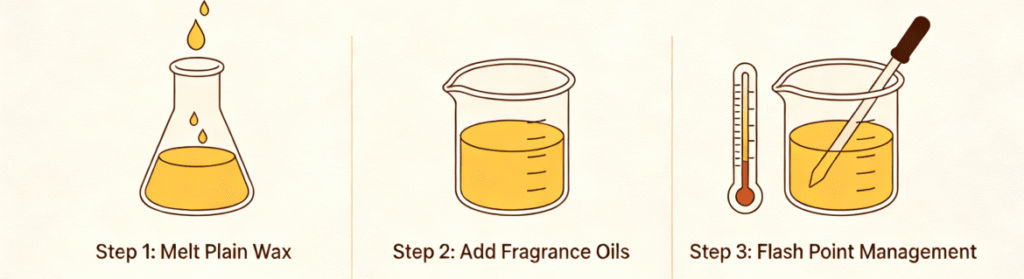
The Controlled Melting Process
Wax is melted with careful attention to prevent scorching and ensure uniformity.
- Temperature Control: Heated to type-specific ranges (e.g., Soy: 180-185°F / 82-85°C).
- Equipment: Double-boilers or specialized melters provide even, gentle heat.
- Monitoring: Constant stirring prevents hot spots.
Precision Fragrance Integration
Adding the fragrance is a science of temperature and timing.
| Step | Temperature Range | Purpose |
|---|---|---|
| Cooling Phase | Wax cooled to ~180°F (82°C) | Prepares wax for optimal fragrance binding. |
| Fragrance Addition | 175-185°F (79-85°C) | Prevents rapid evaporation (“flash-off”) of top notes. |
| Stirring | 2-3 minutes minimum | Ensures complete, even emulsification of oil and wax. |
Professional Blending Techniques
Technique ensures the fragrance is uniformly dispersed throughout the wax batch.
- Slow Pouring: Oil is added gradually while stirring continuously.
- Thorough Emulsification: Stirring in a figure-eight pattern guarantees no oil separation.
- Temperature Maintenance: Heat is carefully managed to maintain ideal viscosity for the next step.
Quality Control During Blending
Each batch is checked before moving to pouring.
- Visual Inspection: For uniform color and consistency.
- Fragrance Test: A “cold throw” evaluation confirms scent strength.
- Temperature Verification: Ensures wax is at the perfect pouring point.
What curing process ensures optimal scent throw?
Curing is the essential, often unseen, stage where the candle’s scent fully develops. Rushing this process results in a weaker, less balanced fragrance.
During the curing process, fragrance molecules fully bind with the wax’s crystalline structure. This action creates a stable matrix that, in turn, ensures the scent releases consistently and powerfully when burned. As a result, curing enhances both the cold throw (the unlit scent) and the hot throw (the scent released while burning).
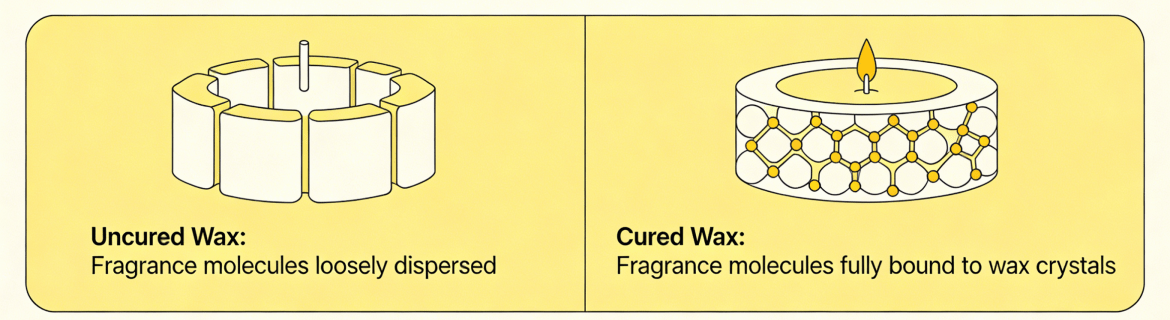
The Science of Curing
During curing, key chemical and physical changes occur:
| Process | What Happens | Result for the Candle |
|---|---|---|
| Molecular Bonding | Fragrance oils penetrate and bond with wax crystals. | Creates a stable scent-wax matrix for even release. |
| Evaporation Stabilization | Volatile top notes settle and integrate. | Prevents scent from fading too quickly. |
| Crystalline Network Formation | Wax forms an optimal solid structure. | Ensures consistent burn and fragrance diffusion. |
Curing Time by Wax Type
Different waxes have distinct curing requirements.
| Wax Type | Minimum Curing Time | Optimal Curing Time |
|---|---|---|
| Soy Wax | 1-2 weeks | 2-4 weeks |
| Coconut Wax | 1 week | 2 weeks |
| Paraffin Wax | 2-3 days | 1 week |
| Beeswax | 2-3 weeks | 4+ weeks |
Ideal Curing Environment
Conditions must be controlled to maximize effectiveness.
- Temperature: Stable, between 65-75°F (18-24°C).
- Humidity: Maintained at 40-60% to prevent cracking or moisture issues.
- Light: Stored in darkness or indirect light to prevent fragrance degradation and discoloration.
- Airflow: Gentle, indirect circulation to ensure even curing.
Testing for Completion
Makers don’t guess; they test. A systematic approach ensures quality:
- Week 1: Check for smooth surface, cold throw, and wick alignment.
- Week 2: Conduct a 2-4 hour burn test to assess hot throw, flame stability, and melt pool.
- Final Assessment: Evaluate full performance, scent consistency, and burn time before release.
How is packaging completed?
Packaging is the final, critical step that protects the finished product, communicates the brand, and ensures the candle reaches the customer in perfect condition.
Packaging combines robust protection with aesthetic presentation. This packaging system serves four key purposes: first, it safeguards the candle during shipping; second, it preserves the fragrance integrity; third, it communicates all vital information clearly; and finally, it significantly enhances the unboxing experience.
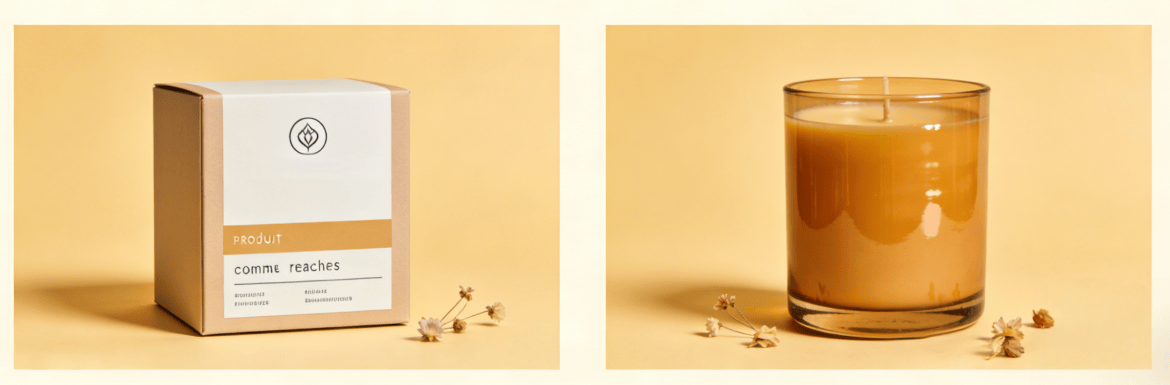
Pre-Packaging Quality Assurance
Every candle undergoes a final inspection before being packed.
| Checkpoint | Standard | Action if Failed |
|---|---|---|
| Visual Inspection | Smooth surface, no imperfections. | Set aside for repour or discount. |
| Wick Alignment | Perfectly centered, properly trimmed. | Adjust or replace. |
| Fragrance Verification | Correct scent, adequate cold throw. | Additional curing or rejection. |
| Label Placement | Centered, straight, clean. | Relabel. |
The Packaging Layers: Protection & Presentation
- Primary Wrapping: Tissue paper or glassine bags cover the candle opening to contain fragrance and prevent dust.
- Stabilization: Cardboard inserts or biodegradable foam cradles hold the candle securely inside the box.
- Retail Box (Secondary Packaging): Made from quality, often recycled, materials. It features:
- Brand Alignment: Design reflects brand identity.
- Essential Information: Care instructions, fragrance notes, materials list, and safety warnings.
- Brand Story: Connects the product to the maker’s values.
Completing the Brand Experience
- Labeling: Uses soy-based inks on recycled paper. Includes bottom labels (batch info), front/back labels (branding/instructions), and safety warnings.
- The Unboxing: Designed to be a memorable, multi-sensory reveal, sometimes including thank-you notes or samples.
- Sustainable Practices: Prioritizing recycled cardboard, biodegradable fillers, plant-based inks, and right-sized boxes to minimize waste.
Shipping Preparation
Candles are vulnerable to temperature, movement, and moisture during transit.
| Protection Layer | Purpose | Materials Used |
|---|---|---|
| In-Box Stabilization | Prevent movement and jar-to-jar contact. | Cardboard dividers, void fill. |
| Climate Guard | Buffer against temperature extremes. | Insulated liners for extreme climates. |
| Moisture Barrier | Protect against humidity damage. | Silica gel packets. |
Final Checks and Storage
- Quality Control: Verify weight, address accuracy, seal integrity, and component completeness.
- Inventory Storage: We store packaged candles in climate-controlled areas, manage inventory with a First-In-First-Out (FIFO) system, and track each candle digitally until shipment.
Conclusion
The creation of a scented candle is a meticulous journey of transformation. First and foremost, it begins with the scientific selection of compatible materials, followed by the precise blending of fragrance. Beyond that, it progresses through the patient art of curing and, finally, culminates in the thoughtful design of protective packaging. Each step, moreover, is guided by a steadfast commitment to quality, safety, and sensory delight. In turn, this behind-the-scenes process ensures that when the wick is finally lit, the candle delivers a perfect balance of beautiful ambiance, captivating fragrance, and clean, safe performance.