Private Label Scented Candle Manufacturer in China | IGNITION



Can Scented Candles Be Used Daily in Commercial Spaces?
scented candles can be used daily in commercial spaces, but they require professional-grade formulations designed for longevity, safety, and consistent performance to manage costs and maintain a pristine atmosphere.
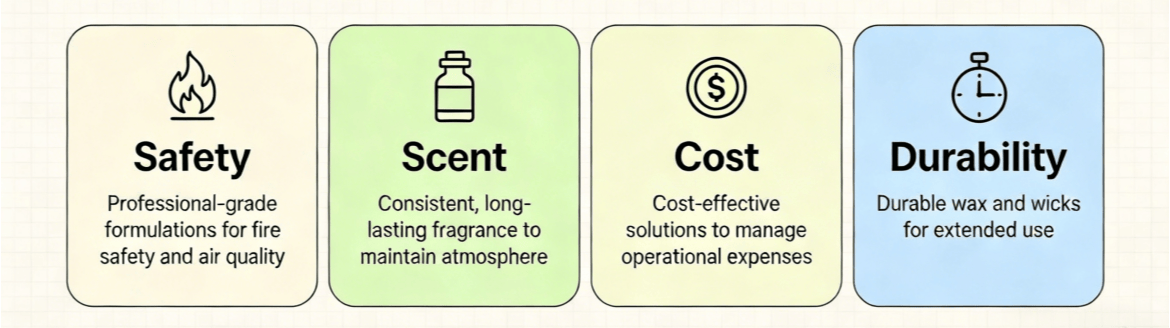
Let’s explore the four pillars of successful daily candle use: safety, scent, cost, and durability. This guide will help you make informed choices.
Do Daily-Burn Candles Demand Higher Safety Standards?
Absolutely. Daily use accelerates wear and increases risk. Candles must meet higher standards for wax stability, wick design, and container safety to prevent issues like overheating, sooting, or flare-ups.
From Materials to Protocols—Building a Safety-First Strategy
Safety for daily use is a system, not just a product feature. It involves the candle’s inherent design and the human procedures around it.
Core Material Standards for Commercial-Grade Candles
Not all candles are built for the marathon of daily burns. The materials must withstand consistent, long-duration heat.
- Wick Engineering: The wick is the engine. For daily use, it must be precisely sized to the wax and container diameter to maintain a steady, medium-sized flame. Lead-free, core-spun cotton wicks are preferred to prevent mushrooming (carbon buildup) and fraying after multiple lightings.
- Container Integrity: Glass must be tempered, thick-walled (at least 4mm), and heat-resistant to withstand constant thermal stress without cracking. Ceramic is also an excellent durable choice.
Implementing a Daily Safety Protocol and Compliance
The safest candle can still be misused. Establish and train staff on a clear Daily Burn Protocol.
Commercial Candle Safety & Maintenance Checklist:
| Task | Frequency | Purpose & Procedure |
|---|---|---|
| Wick Trimming | Before EVERY lighting | Trim wick to 1/4 inch using a proper wick trimmer. Prevents tall, sooty flames. |
| Wick & Flame Inspection | Weekly | Check for “mushrooming” (carbon ball on tip) and flame stability. Scrape off carbon or replace candle if severe. |
| Wax Pool & Burn Management | Per Burn Session | Allow a full melt pool to form, then extinguish after max 4 hours. Let cool completely before relighting. Prevents overheating and tunneling. |
| Container Inspection | During each wick trim | Feel for excessive heat. Look for cracks, deep soot lines, or wax cracks. Replace immediately if damaged. |
| Placement & Storage Audit | Monthly | Ensure candles are on stable, heat-proof surfaces, away from drafts and flammables. Store unused stock in a cool, dark place. |
For high-traffic areas like hotel lobbies or restaurant dining rooms, consider enclosed flame lanterns or candle warmers as a safer, flameless alternative that still provides scent and light.
Seeking Consistent Aroma Quality for Customer Experience?
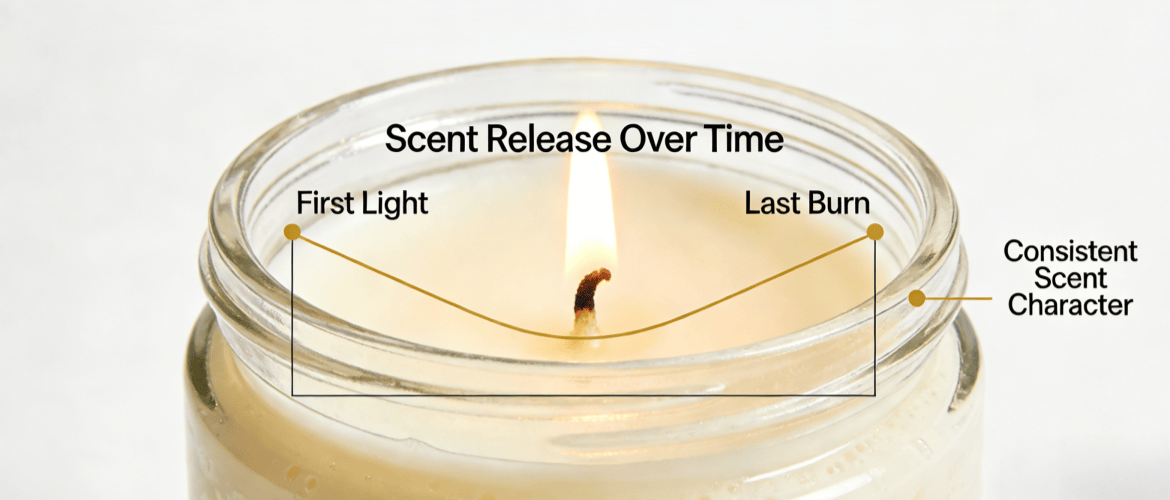
Consistent aroma relies on a high, stable fragrance load in premium wax, paired with optimal wick performance. Professional candles are engineered for a linear scent release, maintaining the same character from first light to last.
The Science, Sourcing, and Strategy Behind Reliable Scent
Consistency is a result of precise formulation and controlled burning conditions. Let’s break down the factors that prevent “fragrance fade.”
The Fragrance “Load,” “Throw,” and “Stability” Equation
For daily use, three metrics are critical:
- Fragrance Load: The percentage of fragrance oil in the wax. Mass-market candles may have 5-6%. For consistent daily performance in a large space, a load of 8-10% is often necessary.
- Hot Throw: The strength of the scent when burning. This depends on the load and the quality/compatibility of the fragrance oil with the wax.
- Scent Stability: The oil’s ability to maintain its profile without top notes burning off too quickly. Professional oils are “top-loaded” and blended for thermal stability.
Achieving Day-to-Day Consistency: Production and Practice
A candle’s scent should not change dramatically as it burns down. This requires:
- Precision Dosing & Batch Testing: Suppliers should use automated systems for accuracy and test 10% of each batch for scent throw. Request this data.
- Proper Curing: After production, candles need 1-2 weeks to “cure,” allowing the fragrance to fully bind with the wax. Burning an uncured candle results in weak, inconsistent throw.
- Full Melt Pool Formation: As covered in safety, a full melt pool is crucial. It ensures the entire surface area of wax is releasing fragrance evenly. Tunneling traps scent in unused wax.
Scent Strategy for Commercial Spaces
Match the candle’s scent strength and profile to the space and brand identity.
| Space Type | Recommended Scent Strength | Profile Examples | Key Consideration |
|---|---|---|---|
| Large Lobby / Atrium | Strong (10%+ load) | Clean linen, white tea, ocean breeze. | Needs powerful throw to fill volume. |
| Hotel Corridor / Spa | Medium (8-9% load) | Lavender, sandalwood, gentle vanilla. | Noticeable but not overwhelming in confined spaces. |
| Restaurant Dining Area | Very Subtle / Unscented | Neutral, clean, or food-complementary (citrus, herb). | Never compete with food aroma. |
| Retail Store | Signature & Medium-Strong | Custom brand blend. | Scent is part of branding; must be consistent and memorable. |
Actionable Tip: Limit your business to 1-2 signature scents. This simplifies quality control, inventory, and strengthens brand recall. Partner with a supplier for custom fragrance development to create a unique aromatic identity.
Need Cost-Effective Solutions for High-Frequency Use?
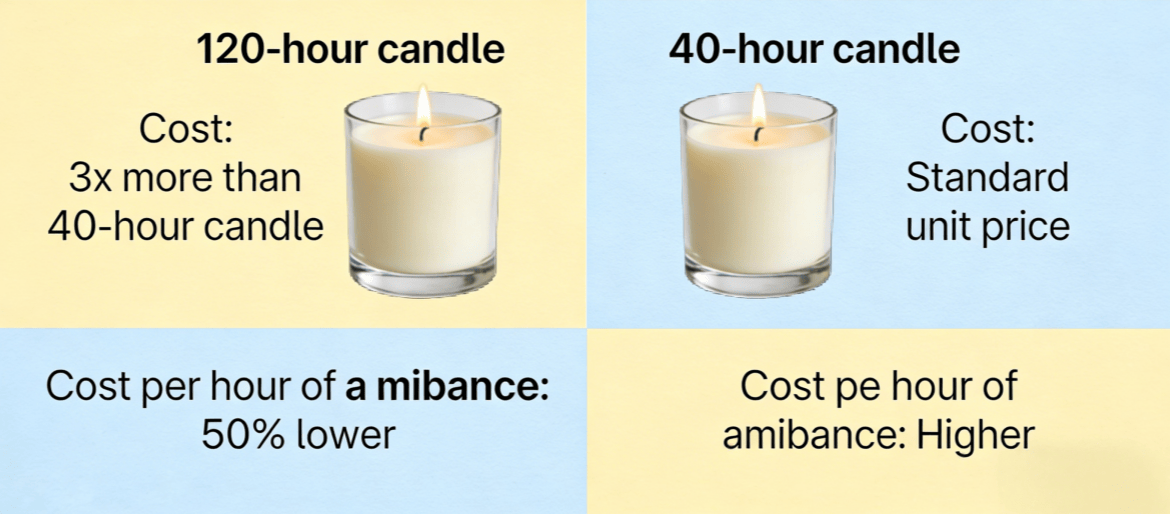
Cost-effectiveness comes from longer burn time and bulk pricing, not a lower unit price. A candle that burns for 120 hours but costs 3x more than a 40-hour candle offers a 50% lower cost per hour of ambiance.
Analyzing Total Cost of Ownership (TCO) for Commercial Candles
Smart B2B buyers look beyond the sticker price. The real cost includes product, labor, and the value of the experience.
The TCO Formula for Commercial Candles
A cheaper candle often scores poorly on all three factors.
Case Study: Cost Analysis of Cheap vs. Commercial Candles
For a hotel lounge using 10 candles, 8 hours/day, 30 days/month.
| Cost Factor | Cheap Retail Candle ($5, 35-hr burn) | Commercial-Grade Candle ($18, 120-hr burn) |
|---|---|---|
| Candles Needed/Month | (10 * 8 * 30)/35 = ~69 candles | (10 * 8 * 30)/120 = 20 candles |
| Monthly Product Cost | 69 * $5 = $345 | 20 * $18 = $360 |
| Labor Cost (5 min/candle @$20/hr) | 5.75 hrs = $115 | 1.66 hrs = ~$33 |
| Monthly TCO (Product + Labor) | $460 | $393 |
| Cost per Burn Hour | $460 / 2400 hrs = $0.19/hr | $393 / 2400 hrs = $0.16/hr |
The commercial candle has a higher unit price but a lower total operating cost and provides a superior, reliable experience.
Maximizing Cost-Efficiency: Bulk, Design, and Systems
- Bulk Purchasing & Long-Term Contracts: Secure 15-30% discounts and ensure supply consistency.
- Optimize Design for Efficiency: Choose wider-diameter vessels that promote an even, full melt pool, maximizing wax use and preventing waste.
- Implement a Refillable System: Invest in durable, branded containers. Purchase only wax refills, slashing long-term costs and reducing waste.
- Track & Manage Inventory: Monitor usage by location to avoid overstocking or stockouts, optimizing cash flow.
Want Durable Designs to Reduce Replacement Cycles?
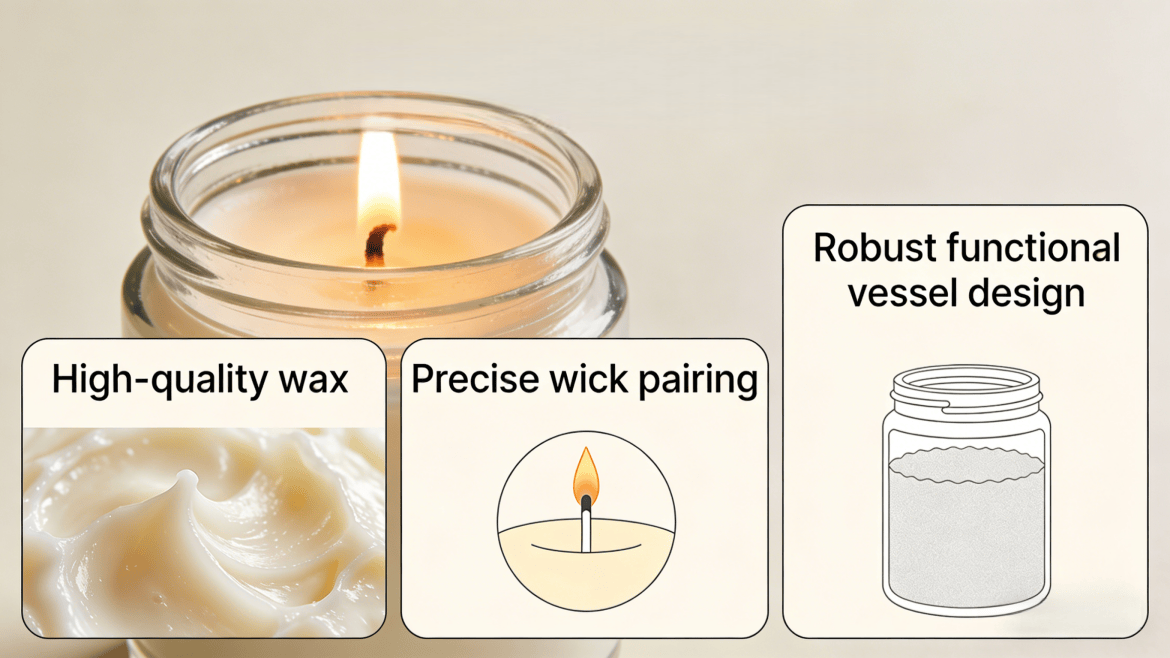
Durability means a candle that burns evenly to the end, maintains a clean jar, and resists damage from handling. This is achieved with high-quality wax, precise wick pairing, and robust, functional vessel design.
Engineering Candles for Endurance, Aesthetics, and Value
A durable candle is a work of precision engineering. Every component must work in harmony under daily stress.
The Three Pillars of Candle Durability
1. Precision Wick Sizing and Quality
An undersized wick drowns; an oversized wick overheats and soots. Suppliers must perform rigorous wick testing for each vessel/wax combo. Core-spun cotton wicks maintain integrity through dozens of lightings.
2. Vessel Design for Form, Function, and Branding
The container is a functional part of the system.
- Material & Thickness: Tempered glass (min. 4mm) or ceramic to handle thermal shock.
- Shape: Straight-sided for easy wax removal and cleaning, facilitating refill programs.
- Lid: A snug-fitting lid is essential for dust prevention and scent preservation between burns in commercial settings.
- Branding: A durable container becomes a long-lasting brand asset.
Durability in Practice: The Lifecycle of a Well-Designed Candle
| Burn Phase | Characteristic of a Durable Candle | Common Failure in Low-Quality Candles |
|---|---|---|
| First 25% | Establishes a full, even melt pool. Strong, true scent. | Tunneling begins, wasting wax. Scent is weak or fleeting. |
| Middle 50% | Consistent melt pool. Clean glass. Stable flame. | Jar overheats. Soot line forms. Flame flickers. |
| Final 25% | Burns evenly to 1/2″ base. Scent remains. Jar stays clean. | Wick drowns. Scent disappears. Glass is blackened. |
| End of Life | Jar is easily cleaned for reuse or recycling. | Wax is stuck; jar is often discarded. |
The Ultimate Business Advantage: A durable, clean-burning candle enables a refill program. Return empty jars to your supplier for refilling at a lower cost. This locks in long-term savings, ensures consistency, and promotes sustainability—a powerful message for your clients.
Conclusion
Daily use of scented candles for commercial spaces is not only viable but advantageous with the right strategy. By prioritizing safety-engineered products, ensuring consistent scent performance, calculating total cost of ownership, and selecting durable designs, businesses can achieve a seamless, cost-effective, and consistently branded ambiance.